
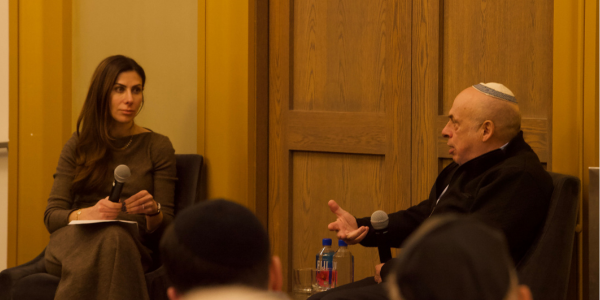
WESTPORT–On Monday, Chabad Lubavitch hosted a “Night of Courage and Freedom” with Natan Sharansky, who spoke about his journey from Soviet political prisoner to Israeli leader and global advocate for human rights.
Born in Ukraine in 1948, Sharansky said his early years were shaped by the Soviet policy of forced assimilation. He described an upbringing in which there were no Jewish books, no Jewish education and little space for religious life. “The Soviets wanted to erase identity because everybody had to be loyal only to communist ideology,” Sharansky explained.
The former chess prodigy shared that the Six-Day War in 1967 catalyzed a shift and awakened a generation to their Jewish identity. Sharanksy said smuggled books and encounters with visiting Western Jews opened his eyes to a different historical narrative. For him, that awakening turned into activism.
The consequences of dissent
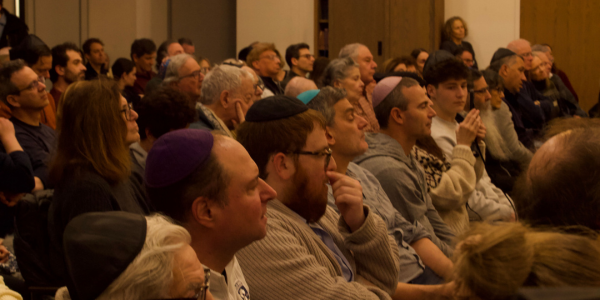
To a packed room of over 100 attendees, Sharansky recounted the consequences of his dissent: constant surveillance, repeated searches, arrest, and eventually nearly a decade in Soviet prisons and labor camps, much of it in solitary confinement. What sustained him, he said, was a small black book filled with encouraging notes. “Without optimism, I could never survive,” he told the audience, sharing that his positivity was the psychological anchor that allowed him to endure the oppression.
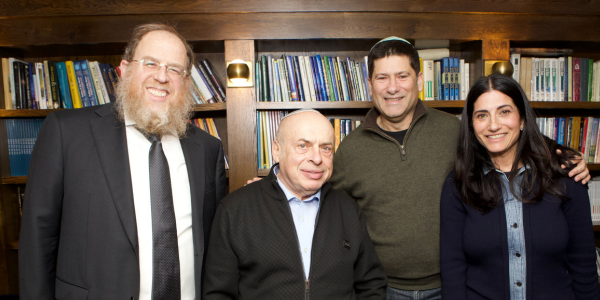
Released in 1986, Sharansky immigrated to Israel, where he quickly entered public life, serving in multiple governments and becoming a leading voice on human rights and Jewish identity. He went on to write Fear No Evil, his prison memoir, and Never Alone. In 2006, President George W. Bush awarded him the Presidential Medal of Freedom.
October 7
When asked about the events of Oct. 7, Sharansky spoke bluntly, calling it “very painful” and “a huge failure of [Israel’s] army, of our intelligence, our government.” But he also pointed to an unexpected source of hope in “our absolutely amazing young generation” who mobilized in large numbers in the aftermath.
Regarding geopolitical challenges, Sharansky argued that lasting peace requires democratic reform and accountability among Palestinian leadership. “I believe in peace with Palestinians only if Palestinians will become a much more open and democratic society,” he said. “I believe that all people deserve to live in freedom.”
Progressives: the anti-liberals
The former political prisoner was especially critical of progressive ideology. “So-called progressives, they are anti-liberals,” he said. “They are against freedom.” Communism, he warned, is being repackaged. “We already discovered once that communists are not our allies,” he said.
Sharansky argued that ideological frameworks intended to protect minorities have, in practice, become hostile to Jewish life. He urged young people, particularly students in the audience, to speak confidently about Israel on college campuses and to defend Jewish identity without apology.
Sharansky also weighed in on American politics, criticizing Jewish voters who supported New York City’s current mayor, Zohran Mamdani. Jewish leaders and voters, he said, “have to blame themselves” for backing candidates whose positions undermine Jewish safety, urging a reassessment of political alliances.
A “tremendous honor”
Rabbi Yehuda Kantor called it a “tremendous honor” to host Sharansky and to share his perspective on some of today’s most pressing issues. “For the course of his remarkable life Natan has been a key actor in the only true forever war, that is the war of liberty versus tyranny,” he added.





Recent Comments