
By John H. Palmer
WESTPORT – The Planning and Zoning Commission is working with a timeline of less than a week remaining of public discourse on the Hamlet development before they must legally begin deliberations of whether to approve the project in Saugatuck.
Representatives of ROAN Ventures, fighting to gain the town’s approval of the project, once again faced scrutiny from town-contracted peer reviewers at a special public hearing Wednesday evening. While they painted a picture of an application that meets, and even exceeds the town’s regulations for parking, traffic, density, stormwater management, and aesthetics on paper, there are still many details that some commissioners and citizens are still not happy with. More than anything, said P&Z Chairman Paul Lebowitz, are countless letters from citizens saying it’s too large for Westport.
“There comes a point where we can’t knock it down anymore,” said Martin Purcell, founding principal for ROAN Ventures. “We’ve been working really hard, tirelessly for years sweating and bleeding into this project to get to where it is today.”
Attorney Eric Bernheim started the evening laying out the developer’s case, adding that the Flood and Erosion voted to approve as submitted Tuesday. Earlier Wednesday, the Board of Selectwomen, acting as the town’s traffic and water pollution control authority, tabled a vote on the submitted traffic plan until P&Z accepts or rejects the application.
“We have been very thoughtful about this development, and we have tried not to max it out according to your regulations,” Bernheim said. “It’s a much better project and we are happy to be discussing it tonight.”
Peer reviewers hired by the town agreed that the application appears to be ready to be sent for a vote, at least on paper. As far as parking, the application at this point provides 271 spaces on the street and in garages, which is 34 more than required and exceeds the required 1 space per 1,000 square feet. Currently, the application provides one space for every 800 square feet.
David Ginter, a peer reviewer with Stamford land use consulting firm Redniss and Mead, said that most of the technical issues with the application have been met.Building heights have been lowered below 60 feet, in conformance with current regulations, and floor areas of the buildings proposed have been kept below 40,000 square feet. A “view corridor” enabling sightlines to the Saugatuck River have been made larger by increasing space between two hotel buildings.
“The applicant has done a good job of addressing all the concerns we have had,” Ginter said. I believe this does meet the regulations as written”
Time is running out
The planners face a major time crunch, as under state law must close the Hamlet application on June 18, beginning a 65-day deliberation period after which a negative or positive vote must be taken whether to approve. In the meantime, commissioners Monday evening deliberated and approved a new positive “8-24” municipal use report for the $108-million Long Lots Elementary School, a crucial step before applying for a state reimbursement grant by June 30.
“I’m not concerned about timeline, I’m concerned about doing it right,” said Chairman Paul Lebowitz. “If we need to, we’ll ask for more time.”
That’s not the first time that Lebowitz alluded to the possibility of extending the Hamlet deliberations. Legally, the commission must close the hearing phase of the application by June 18, and the last scheduled hearing is on June 16. At that point, the commission would enter a 65-day deliberation period. At the commission’s June 2 meeting, Town Attorney Ira Bloom suggested that an option would be to ask the developers to withdraw their application and immediately resubmit it.
This would reset the legal clock, and in essence start the entire approval process over again, giving the commission at least another 65 days of time during which more and public information could be gathered. Theoretically, the commission would not have to use all of that time, but the applicant, which has legal authority at this point given a 65-day extension had already been allowed, would need to agree.
Much of the first evening’s first three hours on Wednesday was spent questioning several peer reviewers that have been poring over the details of the application, including parking and traffic, storm water management, and construction phasing.
Significant attention and discussion was given to the issue of parking for delivery vehicles into the development. While the application’s parking plan gives designated room for delivery trucks – in the form of loading docks and on-street spaces that allow at least two trucks to park outside the lanes of travel throughout the development, some commissioners weren’t satisfied about what would happen in the event of food deliveries such as UberEats.
“In my mind delivery is here to stay, and we want to get it right,” said chairman Lebowitz, theorizing that a driver delivering food is “not giving my vehicle to a valet.”
“They could theoretically be running to deliver to someone sitting on the promenade,” he said. “It comes down to whether we have we thought it through. This is an example of thinking it through early.”
Bernheim said that the parking plan allows plenty of pull-in zones which could be used for food and package deliveries during peak use hours when delivery vans would not theoretically be using those delivery spots.
Another changed traffic plan
Traffic concerns continue to be one of the biggest sticking points of the project, and while developers insist they have done all they can to make traffic flow in the Hamlet palatable, the issues of safety in the “blind bend” area of Railroad Place where the “waterside” garage entrance would be located as well as pedestrian safety continue to be a major concern for commissioners on the fence about whether to approve.
“This is a treacherous curve,” said commissioner Amy Wistreich, who has continuously asked the developers to provide a comprehensive traffic study with input from the police and fire department.
“I’m pro-development but we need to look at whether this is safe. We’re coming down to the wire. We all want to move this forward, but I feel like a broken record. I’ve been asking for this at every single meeting.”
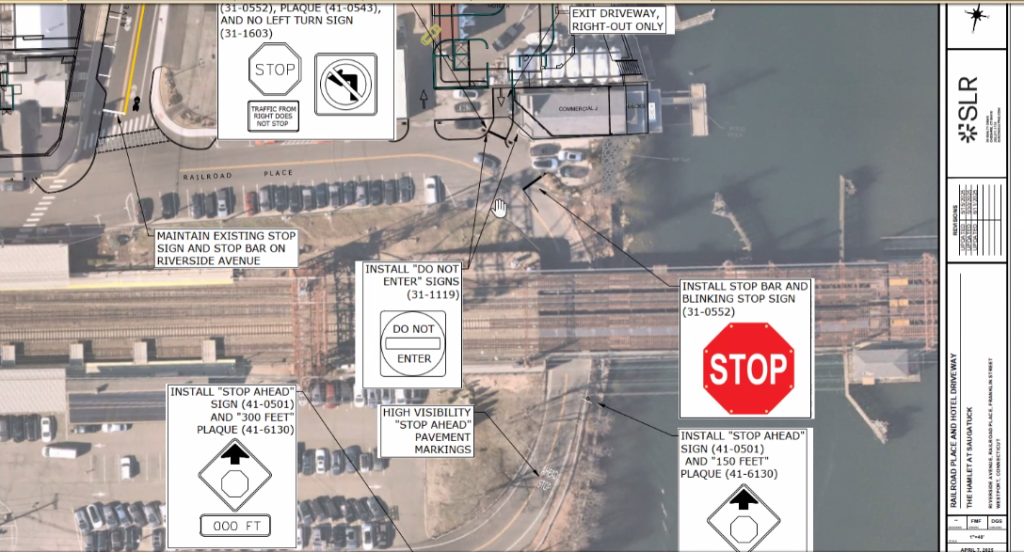
Update traffic plans include a new “English-style” pattern at the entrance to the “waterside” garage at the end area, according to traffic peer reviewer Sharat Kalluri, and would incorporate a “right in, right out” technique that would completely do away with a left hand turn out of the garage and on to Ferry Lane.
Traffic expert David Sullivan said that the plan calls for “installing as many bells and whistles as we can” on Ferry Lane where it meets Railroad Place. High visibility pavement markings, raised pedestrian crossings, and blinking “stop ahead” signs are among the planned traffic-calming measures being employed.
“At all of these intersections we’re improving the flow of traffic and the time you spend at a traffic light,” Purcell said, adding that he expects traffic wait times in the area to improve by 15 to 60 seconds. “The state agrees with our counts. It’s going to show the investments we are making in this infrastructure is going to make traffic flow even better.”
Another issue that came up was the state’s planned replacement of the Cribari Bridge over the Saugatuck River.
“Our (Cribari) Bridge is right in the crosshairs of this development, and we want to know how a future build will affect traffic,” Lebowitz said, and asked what a “Plan B” might look like, and how traffic in the area might be affected by the bridge.
“The assumption is they will rebuild the endpoints of the bridge,” said Sullivan. “You would hope their design would coordinate their improvement in the same progression of the improvements we are making. The intention is to remove bottlenecks and make traffic flow better for all.”
There is talk, Lebowitz said, that the state may be considering a roundabout in that area for better traffic flow.
“I think it’s unreasonable to ask us to have a Plan B for something that may happen in 3 years,” said Bernheim.
About 10 members of the public endured close to 6 hours of discussion before being allowed to make their comments. Most comments centered on traffic and the general look and feel of the development, if it’s approved.
“I believe this project is good for Westport,” said Roger Leifer, a 47-year Westport resident. “These guys have not taken advantage like they could. I applaud them and I’ve seen when they’ve been asked to make a change here and there, they’ve been receptive and responsive.”
He said that he feels the traffic studies don’t take into consideration future growth. “I think we’re going to have robo-taxis in 3 years,” he said, adding that traffic may actually decrease as a result. He also cautioned against the possibility of an affordable housing development being built.
“If this is denied, we don’t get the status quo,” he said. “We’re going to get a massive building that will probably go up 80 feet because an 8-30g has no height restrictions and can’t be in the purview of the P&Z.”
The P&Z next meets on Monday for another public hearing before making a decision to close the application by June 18.
John Palmer, a Norwalk native, is executive editor of the Westport Journal, and has covered community news in Fairfield County and Massachusetts for over 30 years. He can be contacted at jpalmer@westportjournal.com.












This reminds me of post production for a really bad movie.”we can fix it in post”
When the original vision is flawed there are no tweaks that help.
The fatal flaw is the density at our transit hub. This could be a great project in another town. Naugatuck, if they built this in Naugatuck it would be great.
There is no doubt that the principles have put in effort. Its possible to try really hard and to still have a terrible movie. Sometimes a person tries too hard.
It comes down to vibe, wrong town – wrong vibe. You cant put a small city in the way of Westporters and their train– makes zero sense. In Waterbury this would go over… even East Norwalk is a better fit…just not Westport…
ON WHAT PLANET ?
At the end of last nights very long meeting, a commissioner asked the developer about staffing needs, in what appeared to be an attempt to discount the more than 600 staff requirement they stated in their WESTCOG application.
The applicant is claiming they require 80 staff for their development.
This is a stunning lie.
A blatant and bare faced twisting of the truth.
This development which encompasses 11 buildings with a hotel,( and what appear to be roof top bars/restaurants) apartments, an enormous event space with lower food court, restaurant adjacent to the buildings on the water, and approximately 40 retail spaces which the applicant states according to regulations will be split into 30% restaurants, bars, taverns etc, and 70% retail. –
And all the above will require 80 staff.
This response appeared to satisfy several members of the commission.
The applicants then explained in Mumbo jumbo how that number was not actual staffing needs but potential employment that might/might not be created down the road.
The applicant is conveniently and purposely treating the 40 retail spaces as though they are not part of a staffing requirement, and in an absolute shocker this appeared to satisfy many of the commissioners who were clearly and desperately looking for the applicant to set the record straight.
The applicant who is creating give or take 40 retail businesses, down in Saugatuck, appears to be passing onto nobody, the staff needed for what the regulations they love quoting allow which is 30% restaurants, and 70% retail.
On top of that I note that mentioned in this submitted document, in relation to those restaurants is the use of PZ permitted patio regulations, allowing 75% patio space outside, compared with the interior space, effectively almost doubling their size during 6 months of the year.
Think church lane if you need a prime example.
This means even more staff to serve many more diners.
So maybe somebody can help me with last nights blatant misguided explanation of 80 staff.
Math was not my strong suit in school but I did learn my times tables which serves me well to this day.
12 restaurants with staff and outdoor patios will employ anything from 30-60 staff each !
Let’s assume 30, and give the applicant the benefit of the lower number.
30 x 12, = 360.
Well imagine that
Retail spaces 28
Let’s assume 3 staff
28 x 3 =84
Then throw in the standalone restaurant on the water, what appear to be rooftop bars, the massive event space and food court being disguised in an effort to make it sound warm and fuzzy, as a community space.
The cleaning crews, the valets, administrative staff etc..
another 200 staff minimum.
644 staff give or take.
My numbers, without knowing precisely how many restaurants vs retail etc may have a small margin of error – up or down
But CLEARLY, the staff number for the entirety of this project is a lot closer to 650 than to 80.
I sincerely hope the commission does not intend to use a staff number which leaves out the huge retail/restaurant portion of the “build”. Those shops and restaurants are not going to employ robo staff.
Next -the offsite affordable housing.
Where is it ? What is it ? It is part of this application, and TBD, is not good enough.
Is it any wonder that there are folks at state level whom this kind of carry on, infuriated enough to create and pass that monstrous bill. It is precisely this kind of smoke and mirrors that created the monstrous bill sitting on Governor Lamont’s desk.
So AGAIN I ASK TO KNOW, Where is the affordable housing and why is it being kept a secret? Is it going to be replacing already existing affordable housing ?
I suspect that it is, since I have heard the applicant has been desperately trying to secure existing buildings to use.
That tells us that the affordable housing component of this is likely going to just be replacing somewhere already affordable.
Amounting to zero affordable housing gain.
Bravo
I wonder what the applicant will then use the property on Franklin for. 🧐. No doubt another oversized monstrosity which will be applied for in phase 2, quite possibly along with the other buildings left out of phase 1.
Or maybe they will use it to create apartments.
The type everyone is so scared of.
Why wouldn’t they at this point. And how ironic, if they do.
After all they were already given the farm by PZ, who is bending over backwards to make unprecedented allowances to get this passed.
Last I checked the PZ is elected by we the people and it is clear that a vast majority of commenters, and callers, along with the alliance petition signatures, do not want this development.
So much for democracy.
“Our (Cribari) Bridge is right in the crosshairs of this development, and we want to know how a future build will affect traffic,” P&Z Chair Paul Lebowitz observed in the latest hearing on The Hamlet.
Part of Attorney Bernheim’s response: “I think it’s unreasonable to ask us to have a Plan B for something that may happen in 3 years.”
The First Selectwoman has been walking the two projects in tandem since the February 2024 WestCOG meeting when she released the $4.1 million to CTDOT for a replacement to the Cribari Bridge and okayed $12 million dollars worth of brownfields applications to Roan. Chairman Lebowitz rightly points out how each will impact the other and his insight should not be so lightly dismissed.
The people of Westport deserve better than a blind march toward the disaster that these two major changes combined will produce.
As plans move forward to replace the historic William F. Cribari Bridge with a span that can accommodate 18-wheelers, we are careening toward a future that will irreparably damage the character and safety of the surrounding neighborhoods—especially the residential and commercial areas impacted by the proposed Hamlet development.
This is not idle speculation. This is brutal cause and effect.
A wider, higher, stronger bridge means trucks will come. Not “might”—will. No amount of signage or wishful thinking will stop GPS-based routing apps from directing tractor-trailers through the heart of Saugatuck. Enforcement? Right now, every morning overflow I-95 traffic clogs Greens Farms Road and Bridge St. This morning I witnessed the line of traffic ignore the red blinking lights of a school bus trying to pick up middle schoolers. We know it is already too difficult for Westport to protect its school children. The Hamlet will draw delivery trucks; a replacement bridge will allow them. Our children will wait for the busses in air polluted by idling diesle trucks and dodge them when they try to cross. The floodgates won’t close.
Increased congestion. Greater safety risks for pedestrians and cyclists. Air and noise pollution. A complete erosion of the very atmosphere Roan is marketing and Westporters have worked so hard to preserve.
We are not saying: it is reasonable to have a plan. We are saying: there should be no approval without a plan. The Planning and Zoning Commission has a duty—not a suggestion, a duty—to require the following before any approvals are granted:
To proceed without these is to betray the very people who live, work, and walk in this community every day. Once lost, the character and livability of this area will not return.