
By John Schwing
WESTPORT — Do Westport voters want to return a veteran state representative to Hartford who promises that “investing” in his eighth term will pay off for the town and their interests because of his experience and bipartisan relationships? A man who says he knows how to make a difference in the “important work that needs to be done.”
Or do they want a candidate who says it’s time for a change, that Westport needs to be heard in Hartford by a new voice? A man who promises to buck his political party and represent the town in the General Assembly not as a Republican or a Democrat, but simply as “someone who cares about Westport and Westport only.”
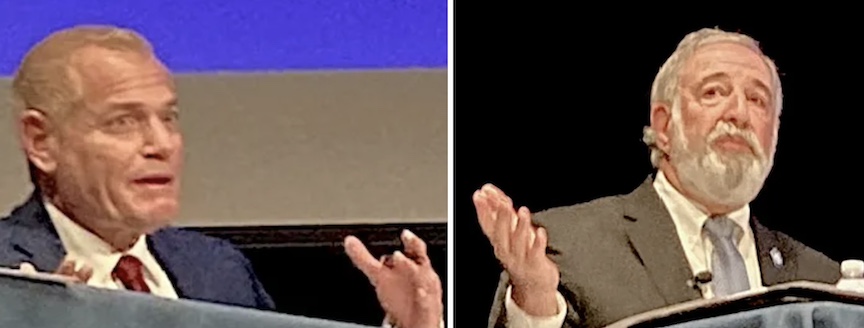
That was theme of a wide-ranging debate Thursday night between the candidates seeking election in the 136th state House of Representatives District: Jonathan Steinberg, the seven-term Democratic incumbent underscoring his experience, and John Bolton, the Republican challenger highlighting a need for change. The legislative district encompasses most of Westport, with the exception of a southwestern slice of town in the 143rd House District.
The debate, which took place at Greens Farms Academy, was sponsored by the Westport Journal. It was moderated by Danielle Dobin, a Democratic member of the Board of Finance, and Dorie Hordon, the Republican vice chair of the Board of Education.
The candidates were questioned across a broad range of topics, from affordable housing and crime to electric rates and gun safety, but the dynamic of experience vs. change colored many of their answers — and triggered the sharpest disagreements.
Affordable housing, in particular, provoked one of the most contentious exchanges of the night.
Both candidates agreed about the value of local initiative, such as the Affordable Housing Fund, which since its inception earlier this year has collected more than $600,000 for town-sponsored projects.
But that was pretty much their only point of agreement on the issue.
Bolton called the state’s 8-30g law a “bayonet” pointed at Westport, adding it was “bad legislation that produces bad unintended, or intended, consequences.” The law allows housing developers to side step local zoning regulations if a community — like Westport — falls short of the 10 percent threshold of affordable housing required by the state.

Steinberg said the state has an “affordable housing crisis, and every community has a role to play.” Westport’s efforts to address the problem are a model for other suburban communities, he said, and he has highlighted those local programs in the legislature.
He said there should be “wholesale” replacement of the 8-30g law, but in the meantime, credited his role working to make “modest changes” over the years, including bipartisan changes made with Republican colleagues. But, he added, modest changes are no longer good enough.
“My opponent has had 14 years to right the ship,” Bolton shot back, “and he has done nada.”
They also crossed swords over statewide housing initiatives — the “Fair Share” and “Work Live Ride” proposals — debated, although not approved, by the General Assembly over the last several years.
Bolton said both proposals should be “dead on arrival” because of threats they pose to local planning and zoning autonomy, while the 8-30g law should be scrapped because it fails to give towns credit for affordable housing projects built prior to the law’s adoption, such as several Westport Housing Authority complexes.
If elected, Bolton added, he would function as Westport’s “eighth planning and zoning commissioner” in Hartford to protect the town’s interests. He currently is serving his third year on the town’s seven-member Planning and Zoning Commission.
Steinberg vowed to “have a seat at the table” during the next legislative session where decisions are made on new housing legislation and lobby for a plan that “has no relationship to 8-30g and works for every community in the state.”
Crime also sparked lively back-and-forth, with Bolton decrying the rash of motor vehicle thefts in town, as well as high-profile incidents like a carjacking on Bayberry Lane in September 2023 and the smash-and-grab robbery at a downtown jewelry store in May. Crimes, he said, he never thought he’d see occur in Westport.
He laid the blame for such incidents on the Democratic-controlled legislature’s adoption of police accountability legislation after the 2020 death of George Floyd in Minneapolis. That “terrible” bill, he argued, was hastily and unnecessarily approved, and signaled a “huge vote of no confidence” in police. The measure, he added, “is punishing law-enforcement” and undermines their ability to do their job.
Steinberg said statistics show crime is declining across the state, but “that doesn’t matter if you don’t feel safe.” Westport is a “target” town for vehicle thefts, he said, because “we have nice cars.”
He acknowledged that he should have talked to Police Chief Foti Koskinas prior to adoption of the police accountability law to hear his concerns, but also contended there are parts of the legislation the chief likes. He added that he had been prepared to buck his party and sponsor an amendment to postpone the controversial “qualified immunity” proviso in the legislation, but deferred to a Republican colleague.
Now that the legislation has been in effect for several years, he added, changes are needed to make sure “the police are protected themselves and they can protect citizens.”
Bolton responded, “I couldn’t agree less,” and contended his opponent’s failure to make changes in the legislation was “at your safety’s expense.”
On a related discussion of gun violence and safety, more disagreement — and some agreement — ensued.
Steinberg said he was proud the General Assembly enacted strong gun-control measures in the wake of the massacre at Sandy Hook Elementary School in 2012, serving as an example to other states. He also supports subsequent measures to crack down on ghost guns and bump stocks, as well as a “red flag” law to protect domestic violence victims and safe firearm storage legislation.

Steinberg added that he is “proud to be a gun reform advocate, and I will continue to do so.”
Bolton, for his part, said, “said I am very much a believer in the Second Amendment” ensuring a citizen’s right to bear arms, even though, “I’ve never fired a gun. Guns scare me.”
But since “guns don’t fire themselves,” the issue of gun violence needs to deal not with weapons themselves but with underlying causes such as mental health, bullying via social media, anger and “disconnected youth.” As a result, some gun-control laws are merely “band-aids” that fail to address fundamental issues, he said.
Steinberg took umbrage at Bolton’s “band-aid” putdown, arguing the red flag and safe storage measures “saved lives” in situations where mental-health issues have been a factor.
Bolton said he agrees with Steinberg on the value of laws like the red flag and safe storage measures. But in reference to a point made by his opponent that there are more guns than people in the U.S., he said there are also more knives and more rocks than people in the country, and the focus needs to be on the underlying causes of violence and not the weapons themselves.
The candidate also tangled over the issue of who’s to blame for the high cost of electricity in the state.
Steinberg said he sought to take on the challenging role of co-chairman of the legislature’s Energy and Technology Committee, which few others wanted, in order to tackle issues “that are very complicated and there are no easy solutions.”
The recent spike in electric bills, he said, can be traced back to a 2017 bipartisan agreement to underwrite the costs of electricity produced by the Millstone nuclear power plant, which otherwise would have shut down and caused the loss of needed energy and jobs. Ratepayers are now being required to cover that cost over a shorter period than expected.
But as those costs fade, Steinberg said, “the real issue is where are we going to get the energy we need going forward?” He said new businesses like AI data centers are huge energy consumers, so “critical investments” are needed now to ensure future power demands for both homes and commerce.
Bolton said he is incredulous that Steinberg and Democrats blame Republicans, who are a “super minority” in the legislature, for having a role in passing “bad legislation” like the 2017 Millstone deal.
Steinberg, who Bolton said promotes his candidacy as an experienced legislative operator, should therefore have anticipated the plan would wind up with consumers being hit with an $800 million bill to reimburse Eversource over only 10 months.
The governor, Bolton added, needs to appoint two people to vacant seats on the Public Utilities Regulatory Authority who would “advocate for a much better deal that you and your cohorts came up with in 2017 and beyond.”
During the course of the debate, which lasted a little more than an hour, the candidates also were asked about issues like unfunded state mandates, economic development, phones in schools, the environment and micro-plastics.
To hear their responses to those questions, click below to listen to a recording of the debate …












John Bolton showed no leadership qualities.. he badgered Jonathan.
He did the usual political bs. And lied !
John Bolton has no clue clearly about business !
Just like Tooker Moore.. it’s a bunch of blind leading the blind.. with a few free dinners thrown in I guess.. most especially by farmers market !
so sorry John Bolton !!!!!! You don’t get to attack Jonathon on the issues . They were mismanaged and ignored by Tooker Moore. ! ,
We are done with this bs !!!!
One point that Mr. Bolton was absolutely correct about, 8-30g that doesn’t given credit for older affordable housing stocks screws a Town like Westport while acting as a gift for property developers. Maybe 8-30g needs to be scrapped, but, in the meantime, it would nice to see progress on this single aspect.