
By Gretchen Webster
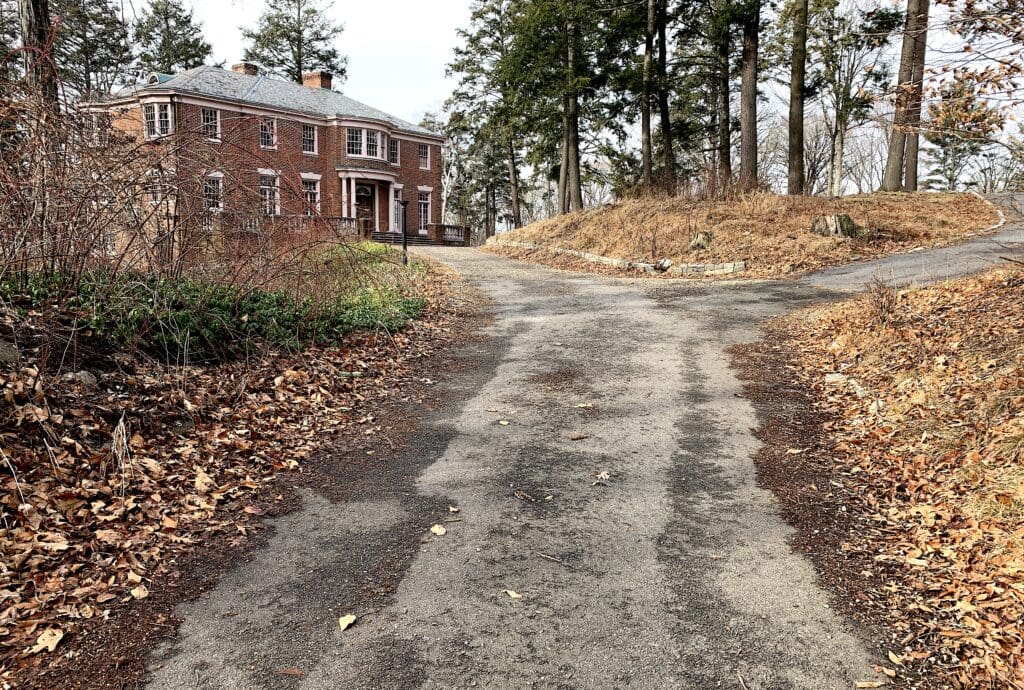
WESTPORT — The future of Baron’s South, the undeveloped 23-acre, town-owned property near downtown once home to a perfume magnate, is again in the spotlight.
A Planning and Zoning Commission subcommittee at a virtual meeting Wednesday discussed how the property might be used, a topic of study — and controversy — that has engulfed the property since it was acquired by the town in 1999.
Strictly limited uses could be expanded
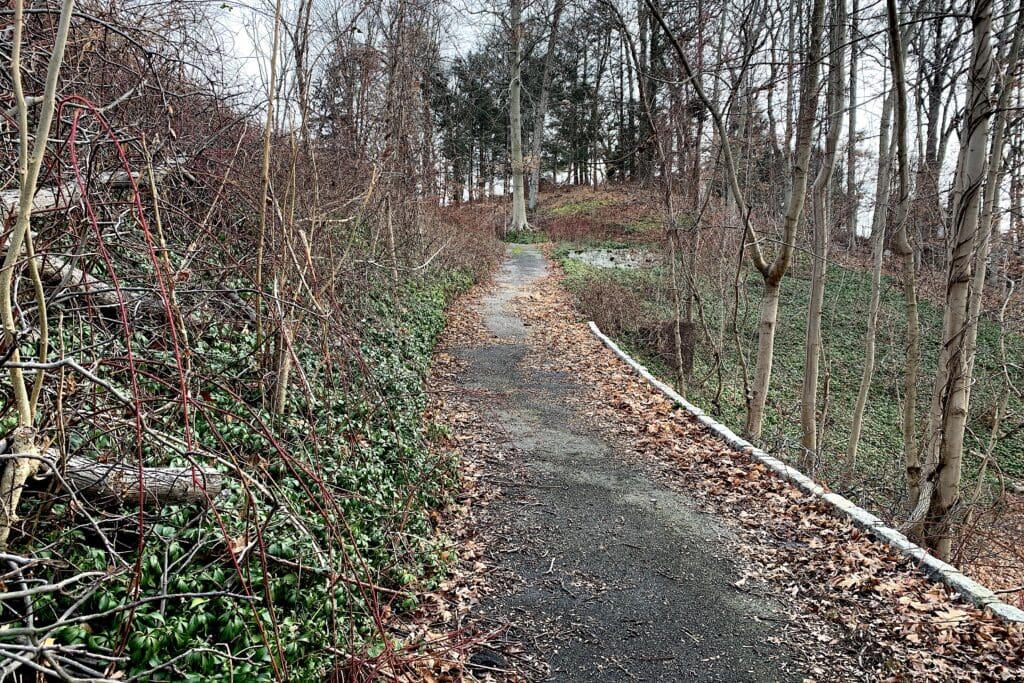
Existing zoning regulations allow only passive use on the site, such as walking or birdwatching, but the Zoning Regulation Revision Subcommittee members favor amending the rules to permit more organized activities. Yoga or painting classes, organized hikes or schoolchildren’s field trips all would be allowed under the proposed amendment.
The Baron’s South property, adjacent to the Westport Center for Senior Activities, has “a great potential for outdoor activities,” Holy Betts, program manager at the center, told the P&Z panel.
“In these COVID times it’s really critical that we’d be able to use Baron’s South. Seniors are more likely to come to an outdoor activity,” she said.
“I don’t see putting anything permanent up,” she added.
Constructing pickleball and bocce courts on the Baron’s South property near the senior center was part of plans for a portion of the land presented to the P&Z in September by the Parks and Recreation Department. Zoning regulations, however, would have to be modified to allow more organized recreational activities on the property.
Existing Baron’s South rules called “oppressively specific”
“The idea behind this regulation change is to permit a wider use of the park,” Danielle Dobin, P&Z chairwoman, told the committee.
The senior center and some educational groups have asked if they could use the property for hiking, field trips or other activities, she said, which currently is not allowed. “Current zoning is so oppressively specific that … an organized hike for second graders followed by story time is not legally allowed,” Dobin said.
But making sure the language of the proposed amendment would be specific was a concern to several people attending the meeting.
Define “passive” vs. “organized” activities
The definitions of “passive” and “organized,” for example, need to be clearly specified if the zoning is amended, said Wendy Batteau, chairwoman of the Representative Town Meeting’s Environment Committee.
Hiking has always been permitted at Baron’s South, she said, but any activities or changes to the property that pollute or cause environmental damage, such as construction of sports facilities or additional parking areas, should not be permitted. And that prohibition must be clearly outlined in any proposed amendment, she said.
“The word ‘passive’ needs to be defined,” agreed Matthew Mandell, an RTM member from District 1 and executive director of the Westport-Weston Chamber of Commerce.
Uses such as picnicking need to be clearly defined to ensure that any new zoning rules do not allow activities that might have a negative impact on the property, he indicated. Specific wording delineating what is permitted and what is not “is certainly better than chopping it up and building things on it,” he said.
The amended Baron’s South regulation, which the committee voted to recommend for consideration by the full P&Z, will be on the agenda for the commission’s next work session at 6 p.m. Thursday, Jan. 13.




I think that all would like the Senior Center to be able to engage in yoga and similar activities. I hope that most would like not to change the rules to allow for pickle ball courts at Baron’s South, though some would. The only issue for me is one of interpretation, i.e. can the existing passive open space language be interpreted to allow for these very limited Senior Center activities. I support Wendy Batteau’s highlighting certain environmental consequences pertinent to “passive”. Those are very important, e.g. limiting Baron’s South usage to quiet activities that involve a limited number of people. The definition of passive is, for me, subject to interpretation and one, that I think, the P&Z could determine would permit the minimalist activities that the Senior Center seeks. The P&Z Commission will decide
As most Town residents who have lived in Westport since 2000 know, the Baron’s South property has had an interesting, storied and controversial history since its purchase by our Town in 1987. Without rehashing all that past, which is fundamentally irrelevant to the matter at hand, I feel it might be instructive (and important) to at least understand the current protective DOSRD (Dedicated Open Space and Recreational District) regulation as it pertains to the current Planning and Zoning text amendment proposal. In my opinion this is the best (perhaps only) way to comprehend the veracity or falsity of the opinions and commentary being cited pertaining to the P&Z’s current intention to modify the current DOSRD#2 regulation.
In brief, without getting into any political or contentious weeds, subsequent to the Baron’s property purchase, concerted efforts were initiated to protect certain specified Westport parcels from development; subsequently in 1996 the DOSRD zoning designation was contemplated with the primary intention of preserving valuable “Open Space” while permitting the public to engage in passive recreational activities that would have zero or negligible environmental impacts. In 2004 this DOSRD concept was adopted via a P&Z text amendment, a special dispensation was granted to create and expand The Center for Senior Activities within the Baron’s South DOSRD property, and subsequently over time three distinct DOSRD designation categories (#1, #2, and #3) – each with its own defined use allowances, were created (with the potential for a #4 related to Longshore and Compo Beach where active recreation was permissible). Over ensuing years there were several new text amendment revisions and modifications to the original text amendment. For the sake of brevity and relevance, I will concentrate only upon the Baron’s South (only existing DOSRD#2) property.
Because the current P&Z is asserting that the current DOSRD#2 (Baron’s South) regulation REQUIRES yet another text amendment modification in order to permit innocuous activities such as “organized” “guided nature walks, painting and yoga classes”, I thought it was quite curious, and likely improbable, that the dedicated founders of the DOSRD would have prohibited such innocuous impact-less activities from occurring on the DOSRD#2 Baron’s South – and it seemed to me that the current P&Z was focused upon the word “organized”.
So I reviewed the historical DOSRD text amendments, the operative 2016 text amendment #704’s DOSRD#2 language, AND watched the several archived P&Z meetings that discussed, formulated and approved the 2016 text amendment #704 that our current P&Z Commission is now poised to modify. Observing and listening to the deliberations and explanations at these meeting provides the insight and perspective necessary to decide what, if any modifications, are required to allow “organized guided nature walks, yoga and painting classes.”
As I suspected, in my opinion at least, the proposed modifications to the DOSRD#2 language is not only unnecessary, but would actually undermine the well founded intention of the 2015/2016 P&Z Commission’s decision to eliminate the existing delineated list of activities from the DOSRD#2 language. P&Z Director Larry Bradley explained that the P&Z Commission’s primary obligation and purpose was to regulate ZONING “USES”, improvements, structures and facilities, rather than regulating “ACTIVITIES” that took place – therefore it was determined that a prescribed activity list was not only inadvisable but did not belong in the document.
Mr. Bradley used the example of “kite flying” (which WAS codified on the DOSRD#2 “list”) and “frisbee throwing” (which was ABSENT from the list), as both being “ACTIVITIES” that do not belong codified in a P&Z regulation. The director confirmed that the role of the P&Z Commission was to codify permissible facilities, structures, improvements and USES – and not the specific ACTIVITIES that would take place on the facilities, structures and uses. In my opinion, common sense also dictates that such a codified list in regulation is prone to errors of commission and omission. THEREFORE, a decision was made to remove any specific activity from the DOSRD#2 codified language – not because “jogging” was not a permissible activity, but because it simply did not belong codified in regulation.
So the real issue at hand now is how to best determine (and regulate) what recreation is permissible on DOSRD#2 property (ie Baron’s South) without codifying specific activities. Do we really need to modify the operative (2016 text amendment #704’s) regulatory language to do this? OR like Don Bergmann recently wrote, who would stop someone from kite flying, frisbee throwing, taking children on a nature walk, or holding a painting or yoga class? I too suspect no one. But of course I could be wrong.
So I reviewed the actual text amendment #704 language and discovered: “The purpose of a DOSRD#2 designation is to allow certain Town-owned open space areas to be maintained for passive or non-organized recreation in a natural and undeveloped setting with no new buildings or structures being erected ….” In other words, passive OR non-organized recreational activities. There is NO qualification regarding passive activities, and the regulation makes no DISTINCTION between organized or non-organized passive activities. “Organized passive activities” ARE NOT prohibited by text amendment #704. There is NO prohibition from having the desired “organized” passive activities – such as painting classes, yoga classes or nature walks (at least in my opinion). As I recall, this same opinion was recently expressed byCathy Walsh (one of the P&Z commission originators of text amendment #704’s language). I imagine that if queried, the 2016 P&Z Commissioners Cathy Walsh, Chip Stevens, Alan Hodge and Jack Whittle would agree that there was never an intention or created language prohibiting such innocuous passive activities from taking place. In my opinion, the current abhorrently neglected condition of the Baron’s South does far more to inhibit such passive activities than any current regulatory language.
ALSO IN MY OPINION, instead of modifying the current DOSRD regulation with language that is in direct contradiction to the basic rationale of the prior P&Z, inviting unintended consequences that text amendment modifications are vulnerable to, the current P&Z would be better served to spend its time DEFINING what is meant by “passive” vs. “active” for the purposes of DOSRD recreation.
Westport is hardly the first community that has addressed the very issue of activities permissible within designated protected open space. A simple google search finds many suitable, well tested definitions of what constitutes a “passive” vs “active” recreational activity that any community can chose from, without resorting to an all inclusive list of specific activities – such activity lists have merely served as “examples” of passive vs active activities. An activity definition can be based upon the intensity and duration of energy necessary, or the potential impact upon the activity has upon the environment, or the safety of co-users, or the necessity for special equipment/facility/structures. There are several definitions that the current P&Z can chose from which would suit our DOSRD purpose. In fact, the current DOSRD language states “with no new buildings or structures being erected” which already prohibits basketball courts, tennis courts, pickleball courts, swimming pools, etc from being erected on the DOSRD#2 Baron’s South property.
In addition, once the Baron’s South IS finally rehabilitated and its grounds become more attractive, the Town would be best served by creating a permitting process for any “organized” classes and events in order to control utilization, scheduling, participants, traffic and safety. Perhaps the same process for holding events at Winslow Park can be utilized – the P&Z with the RTM can best decide this.
In conclusion, having reviewed the current DORSR#2 regulatory language, the historical DOSRD intentions, and watching the pertinent archival P&Z meetings, I do not believe that a text amendment revision of the current DOSRD#2 regulation is necessary in order to permit the current P&Z’s asserted desire that they merely wish to permit “the organized passive activities of guided nature walks, yoga classes, and painting classes”. Their proposed text amendment language is not only unwarranted to this aim, but codifying activities in regulation is contrary to the purpose of the P&Z Commission and contradicts the stated mission of the prior P&Z Commission. In addition, certain specific activities at the exclusion of others do not deserve codification in regulation and can become a foolish endeavor. Existing regulatory language already inhibits the creation of organized active recreation such as basketball, volleyball, tennis, pickleball and swimming pools within DOSRD properties – so the new language that the current P&Z wishes to incorporate seems unnecessary – but merely defining the meaning of prohibited “active recreation” would add a further level of prohibition without resorting to a regulatory modification. I urge the current P&Z to reconsider their current determination to modify the existing DOSRD#2 regulation, and instead to focus upon reaching consensus of a definition of what constitutes a “passive” vs “active” activity for the purposes recreation upon the DOSRD properties, and creating a “permitting process” to control any “organized” activities that would take place.
And after all these years of neglect, making a concerted effort to ensure that the Baron’s South property finally gets the extensive rehabilitation that it deserves.
Being the weekend I’m not sure how many Westporters will read this letter. I at least hope that the members of our P&Z Commission take the time to do so, and use my opinions during their January 13 work session deliberations.
But again, just my opinions.
Jay M Walshon MD FACEP
Westport
PLANNING is the antithesis of hastily crafted zoning regulations motivated by a knee-jerk response to a new or perceived problem.
Doctor, the pinpoint accuracy of your letter takes my breath away.
Jay, you are absolutely correct. Larry Bradley left, someone began misinterpreting our regulation.
It boggles my mind that it appears that only you had the common sense to go back and review the tapes.
Chip, Al , Jack and I along with our democratic collegues, and P&Z director were very clear in all our meetings and in the drafting of the reg. No further definition is needed. This is now all political theater .
This debate about the current passive-use zoning status at Baron’s South got started when the Parks & Recreation Department and Commission (PRD/PRC) started eyeing the site to put pickleball courts on it. I won’t dredge up the battle that ensued to fight off that idea but simply stated, pickleball is an active use, not a passive use. Done deal. Sort of.
Though it’s true that the town needs more pickleball courts, the PRD/PRC’s reason for trying to put them at Baron’s South was their claim that Baron’s South isn’t used much by the public. In actuality, the real reason the property isn’t being used by the public is because the PRD/PRC and the town have nearly abandoned all upkeep of the property for two decades.
In a new attempt to encourage use, town bodies are claiming that the property’s zoning status, which allows only “passive, non-organized uses,” prevents activities like yoga, meditation, and art classes from occurring there. They also claim that it prevents gatherings for activities like bird-watching and hiking.
As Dr. Walshon points out above, Barons South’s 2015 DOSRD #2 zoning designation was never meant to prohibit passive uses like those named above, nor to prevent small groups of people from doing passive things. We all have the basic good sense to know the difference between an active use and a passive use. We also know the difference between organized team and competitive uses compared to small gatherings that are educational, peaceful, observational, and soulful.
The DOSRD #2 zoning reg isn’t broken and doesn’t need fixing. As for Baron’s South, it doesn’t need a zoning amendment to encourage passive users. What it DOES need is some good ol’ common sense and some minimally intrusive, environmentally sensitive, tender, loving care.
I hadn’t seen Cathy Walsh’s comment when I posted my opinion above. Kudos to Dr. Walshon and to Cathy Walsh (and her former P&Z colleagues) for their insights.
For further clarification and emphasis, the current operative 2016 Text Amendment #704 40-1 PURPOSE language does not read “…passive, non-organized uses…”; rather it reads “passive OR non-organized recreation. ”
This grammatical distinction might seem picayune; however the OR (rather than a comma) makes it clear that “passive” activities are distinct, and that provision 40-1 is not prohibiting yoga classes, painting classes, guided walks, etc.
Hopefully the P&Z commissioners will realize this.
It would be shortsighted and counterproductive if we’re were to permit the entirety of the Baron’s South property to remain designated open space, even if we were to carve out some exceptions for active recreation.
We made a regrettable mistake when we did an end run around the Rise proposal for senior housing without ever affording it a hearing. Now we have an opportunity to rectify that mistake.
Surely there are many uses that might be established on a small (2 or 3 acre) portion of the property which already supports pre -existing buildings would be of far more benefit to the community than unused and poorly maintained open space.
Larry – Well said.
It’s a little disappointing that it required a private citizen (thank you for your public service, Jay) to explain DOSRD2 to the P&Z. The real issue, as others have observed, is the current disposition of Barons South. The widespread damage that the town has permitted to occur on this parcel is absolutely scandalous.
Parcels of open space need to be more than just warehoused to protect against future development. Unused open space is wasted space. The town has an obligation to provide opportunities for public enjoyment of these public lands. Limiting use of such space is actually discriminatory if the municipality in essence dictates who can use the land and for what specific and narrow purposes. This excludes large segments of the population from enjoying the property other than being able to stand upon it. The idea of specifying the methods of enjoyment is bizarre. All taxpayers finance the use of the space by subsidizing the loss of tax revenue. A far better approach is to list what activities cannot be engaged in (ie. campfires) instead of dictating what is allowed. We define how the public enjoys our beaches with a short sensible list of prohibitions. We don’t define what we can do on the beach.
Limiting parking is another method of exclusion. Why shouldn’t there be additional parking in order to extend access to the benefits and enjoyment of these parcels. Availability in moderation seems to be a fair approach.
What needs further discussion is the extent to which permanent facilities should/could be built. On one hand there is certainly good argument in favor of keeping these parcels relatively pristine. But there is also good argument for a combination of uses. Central Park is a wonderful property with beautiful natural sections and also sections for recreational enjoyment. Both live in harmony.
Agree with Mr. Walshon on the amazing power of “Unused open space is wasted space” as a rallying cry for all developers. Saying the quiet part out loud is an interesting strategy.
Attorney Nayor:
I’d like to address the odd mixture of statements in your comment:
1. “Unused open space is wasted space”- now THAT’S a developer’s mantra if ever there was one. Wall posters, desk placards or T-shirts anyone? I wonder if the U.S. National Park Service, State Park System, Department of Forestry, Department of the Interior, etc etc. and the enormous biodiversity that resides there ascribe to THAT lie. I guess that next we should question the value and legitimacy of the conservationists and environmentalists amongst us.
2. “The Town has an obligation to provide opportunities for public enjoyment of these public lands” – Baron’s South has been worse than neglected by the Parks & Recreation Department because of their admitted “uncertainty” of how to proceed – despite having a well reasoned and desirable rehabilitation plan in hand for years. Simply funding and enacting this restoration plan will provide a plethora of opportunities for public enjoyment to occur.
3. “Limiting the use of such space is actually discriminatory if the municipality in essence dictates who can use the land and for what specific and narrow purposes.” – Really? Virtually every piece of property has utilization limitations. Baron’s South would be open to ALL persons without discriminatory regulations, and permissible activities is already appropriately controlled by regulation based upon Text Amendment #704 – without “discrimination”. Prohibiting certain kinds of “development” is at the very heart of land use control – and the charge of the Planning and Zoning Commissions across the nation. This comment reinforces the need to have strong open space protections in place.
4. “This includes large segments of the population from enjoying the property other than being able to stand upon it.” – See number 2. Once rehabilitated as has already been recommended, the ENTIRE population would be able to enjoy the Baron’s South property.
5. “The idea of specifying the methods of enjoyment is bizarre.” “A far better approach is to list what activities cannot be engaged in instead of dictating what can be allowed”. – While creating “lists” of what is permitted and/or what is prohibited IS a potential approach, for reasons already mentioned, the concept of distinguishing between passive and active recreation has proven to be a more acceptable means when protecting open space where controlling environmental impact is the goal. Multiple such definitions currently exists – including a Federal definition under the EPA – and are currently being utilized by local municipalities around the country. For example: “Passive recreation refers to recreational activities that do not require prepared facilities like sports fields or pavilions. Passive recreational activities place minimal stress on a site’s resources; as a result they can provide ecosystem service benefits and are highly compatible with natural resource protection”. “Active recreation refers to a structured individual or team activity that requires the use of special facilities, courses, fields or equipment.” Lists of activities serve the purpose of passive and active examples. There are other usable definitions to chose from as well. I believe that Westport might already have an appropriate definition in place.
6. “What needs further discussion is the extent to which permanent facilities should/could be built”- That discussion has already occurred and has zero to do with the recreational utilization of Baron’s South that is currently under discussion.
7. Central Park is a wonderful property with beautiful natural sections and also sections for recreational enjoyment” – Last I checked, Central Park in NYC is 843 acres; Baron’s South is 22? Last I checked, there were no housing developments, assisted living, or corporate office buildings in Central Park. Baron’s South is dedicated protected open space that PERMITS a plethora of passive activities to take place.
Westport’s Text Amendment #704 already addresses this issue quite clearly. All that is necessary is the recognition of what constitutes a passive or active recreational activity, perhaps enacting a permitting process for organized passive uses, enforcement of the current Text Amendment #704 regulation AND REHABILITATING THE PROPERTY SO THAT THE PUBLIC WILL DESIRE COMING THERE.
I am optimistic that our current P&Z led by Danielle Dobin will lead us to the conclusion of this unnecessarily contentious issue, and FINALLY see that the Baron’s South property gets rehabilitated and utilized as it is currently supposed to be.