
By Mark Pazniokas / CTMirror.org
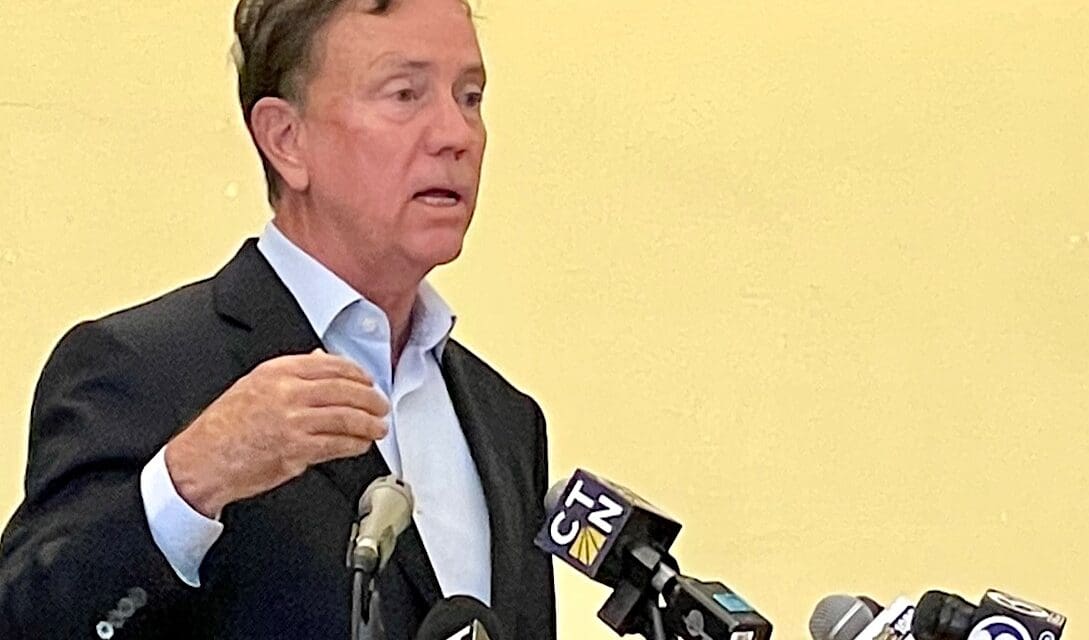
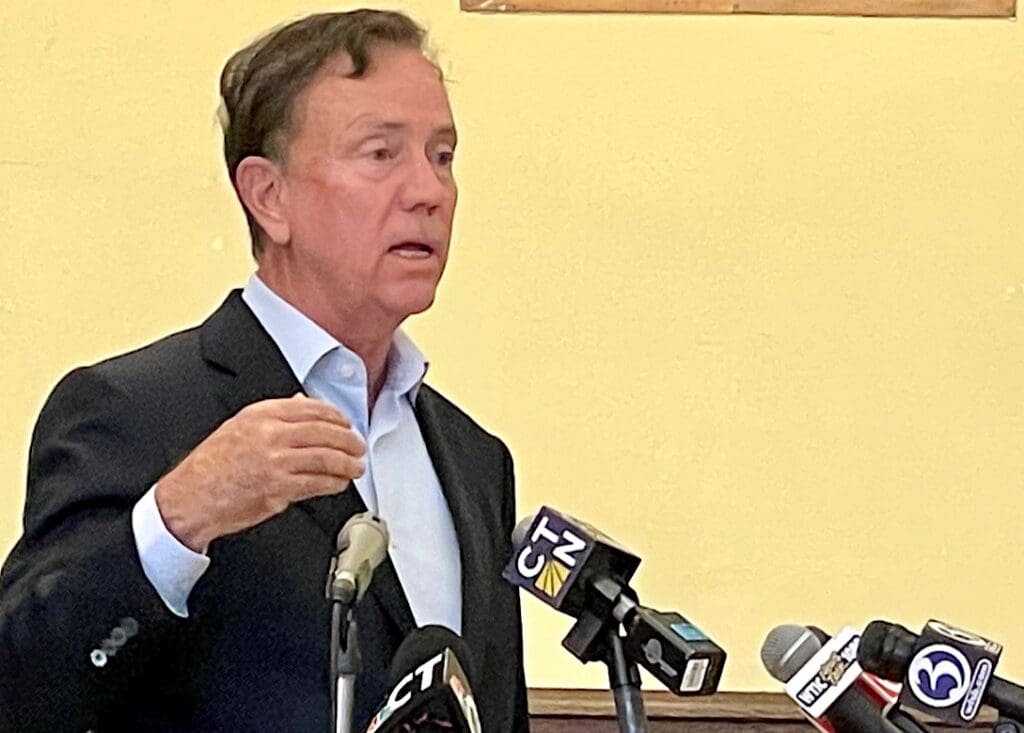
Gov. Ned Lamont clarified Tuesday, his first full day as a candidate for re-election, what he muddied Monday: He has no doubt he will be the Democratic nominee for governor in 2022.
Ambiguity arose Monday when Lamont told reporters he had filed papers creating a candidate committee, then added, “I’ve got to make up my mind formally in the months to come, but I figure let’s be prepared.”
So, does the governor really have to make up his mind? Does he have any doubt about being the Democrats’ nominee?
“I think we’re making a difference”
“No, I love the job. I think we’re making a difference,” Lamont said. “And I just didn’t want to get tied down in the politics of it for the next six months, so I kept it a little ambiguous.”
But on Tuesday, Lamont said there is no ambiguity: “I’m ready to go.”
Low-key campaign rollouts are not unusual for incumbents who have given every indication that they intend to run again. Ambiguity is something else.
His predecessor, Dannel P. Malloy, a fellow Democrat, told reporters at the conclusion of a press conference in the atrium of the Legislative Office Building in March 2014 that he and Lt. Gov. Nancy Wyman had decided to seek a second term later that year.
Behind the seemingly casual announcement, which was applauded by lobbyists and other onlookers at the LOB, was a kickoff plan and clear message: Malloy was running and raising money.
The applause had barely ended when Malloy’s campaign sent an email blast to launch a campaign website and solicit supporters for the first of the $100 contributions Malloy needed to qualify for public financing.
Financing is fundamental to gubernatorial contenders
At Lamont’s urging, Matthew Brokman, the chief of staff to House Majority Leader Jason Rojas, D-East Hartford, and an experienced political organizer, is about to take over day-to-day operations of the party as its executive director. But Brokman also intends to work part-time as Rojas’ chief of staff, a job share that may prove untenable.
Central to the job is fundraising, including potentially from state contractors who can give to the party’s federal campaign account, but are barred from donating to legislators and other candidates for state office.
Lamont, 67, who largely self-funded his $15.9 million campaign in 2018, does not face the same financial pressure as did Malloy, who was publicly financed, or candidates who intend to raise money from donors.
One of the questions yet to be answered is the degree to which his two leading potential Republican opponents, Bob Stefanowski and Themis Klarides, can or will self-fund a campaign.
Klarides, the former leader of the House Republican minority in the General Assembly, has registered as a candidate with the state Elections Enforcement Commission but has not formed a candidate committee.
The registration allows her to spend her own money. Forming a campaign committee would allow her to begin raising money.
According to her most recent filing in October, Klarides has spent $195,749 of her personal funds since registering in May, assembling a stable of strategic, digital and media consultants.
Her strategic consultant, Battleground Strategies, is a partnership of three political operatives, including two former top staffers of the GOP in Connecticut, Jim Conroy and Elissa Voccola, and Jim Barnett, the former GOP chairman in Vermont.
Conroy managed the campaign of Gov. Charlie Baker of Massachusetts. Barnett’s resume includes the re-election of Gov. Larry Hogan of Maryland. Voccola was the northeast political director for the Republican National Committee during the Trump administration.
Klarides did not return calls for comment Monday or Tuesday. Her campaign issued a statement saying Connecticut is “less safe and less affordable” under Lamont.
Stefanowski, the GOP’s nominee in 2018, declined comment. He largely self-funded his primary campaign, then began raising money as the GOP nominee.
Lamont to campaign on COVID record, state’s economic rebound
On Tuesday, Lamont said he feels he has a good message for his re-election campaign: Connecticut has made progress with its finances, its economic climate and COVID-19.
“I think the state made extraordinary progress over the last three years,” Lamont said. “We had moving vans leaving the state, businesses leaving the state, people being a little bit down on the state. I think three years later, the moving vans have turned around, businesses are coming back to the state, [we] got our fiscal house in order.”
Connecticut now has a $3.1 billion “rainy day” fund — enough for state government to operate nearly 70 days. Its growth is attributed to an aggressive savings program and a surging stock market, as well as federal coronavirus relief.
The governor’s management of the COVID-19 pandemic generally gets high ratings in polls. But extension of his pandemic emergency powers is opposed as unnecessary by Republicans in the General Assembly and is likely to be a campaign issue, as is his mandate of vaccinations for state employees and the continued mask mandate for schools.
Lamont spoke to reporters Tuesday after an event at an elementary school in New Britain promoting a program designed to develop a more diverse workforce of teachers. One of the attendees was U.S. Rep. Jahana Hayes, D-5, a former national teacher of the year
Both dismissed a theme Republicans are trying to develop for 2022, claiming that Democrats favor teachers over parents and parental rights are being abrogated by public school systems across the U.S.
Lamont said every school system wants parental involvement.
“I’ve got enough real problems. I don’t need people making up problems,” he said.
“It’s a made up problem,” Hayes said. “You want parents actively engaged and involved. I’m a parent and a congresswoman. So I want to be a part of my child’s education.”












Recent Comments