
By Gretchen Webster
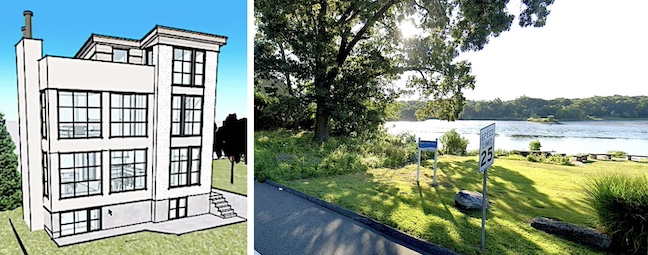
WESTPORT — Many people, including several Planning and Zoning Commission members, have called plans to build a home on a sliver of riverfront land next to Eloise A. Ray Park unfortunate.
But when the P&Z approved the 79 Riverside Ave. application by a 6-1 vote Monday, it was clear commission members did so because the plan met all pertinent regulations — not because they liked the proposal.
“We should consider a moratorium for building on the river for whatever space is left,” said John Bolton, the only commission member to vote against the application. “We have to put our foot down. We have to take a stand.”

The plan to build the single-family house on the 0.09-acre plot, proposed by Lucien Vita last year and revised in February, was the subject of a P&Z hearing last month that was continued to Monday night’s meeting.
Over that period, opponents of the proposal — members of the public and several commission members — bemoaned the fact that the town failed to previously acquire the undeveloped building lot fronting on the Saugatuck River.
The site was designated a building lot in 1922. But no one ever bought it and officials through the years refused to buy it for the town because it was considered unbuildable.
Now, decades later, the tiny lot next to a public park it is just as unbuildable as it ever was and the application shouldn’t be approved, neighbor Charles Tirreno told the P&Z.
Concern about the permeability of the planned driveway was brought up by P&Z member Michael Calise, who said he had suggested that town officials buy the property, but “was turned down dozens of times.”
The driveway has been designed with several layers of materials to absorb water, Bryan Nesteriak, an engineer for the applicant explained. It will be constructed with 24 inches of stone in varying sizes and topped with permeable asphalt “so that water can flow directly through it,” Nesteriak said.
Screening the house from views by neighbors and the town park next door has also been a major consideration during the P&Z review of the application.
“I’d like to see you add to the planting budget … so that you can add lower plantings,” P&Z Chairman Paul Lebowitz told Vita on Monday. Adding plantings that are shorter would fill in the property’s borders and better screen it from neighbors and the park, he said. “You could work with Parks and Rec on that.”

Vita agreed to augment the landscaping plan.
Removing a large, spreading oak tree in the middle of the property concerned commission member Patrizia Zucaro, and Tirreno. “We really should do something about the tree, can we do something with it?” Zucaro asked, suggesting that it could possibly be moved or kept intact on the site.
Tirreno said that if the tree had to be cut down, it could be used as “a snag,” by laying the tree on the ground, “to allow it to continue to act as habitat” for wildlife. The P&Z, however, cannot stipulate how a property owner disposes of trees or anything else removed from a property, Lebowitz said.
Commission members discussed whether it would be possible to deny the application based on the town’s Plan of Conservation and Development. They talked about whether that plan gave the commission the authority to limit expansion in a coastal area or any other basis to deny the application.
The property owner’s Coastal Site Plan application, which specifically requires the P&Z to determine if the project complies with Coastal Area Management regulations, is a factor the commission needs to consider in deciding on the project, Lebowitz said.
“We are faced with a question as to whether or not something complies with our regulations — not whether we like it or not,” the chairman said. He had examined the application closely, he added, looking for anything that might prevent the project from being approved, but found no reason it could be denied.
Lebowitz also asked Michelle Perillie, the planning and zoning director, if the application complies with regulations. It does, Perillie said, including engineering, conservation, flood zone and health district regulations.
After the P&Z considered postponing a vote on the application once again, members decided to grant approval because the schedule to make a decision was set to expire Friday, Oct. 11.
Freelance writer Gretchen Webster, a Fairfield County journalist for many years, was editor of the Fairfield Minuteman and has taught journalism at New York and Southern Connecticut State universities.








The hand wringing is just brutal. In the real world (private sector) people lose their jobs over bad decisions or non decisions. Shameful…
Bravo John Bolton. A moratorium on further riverfront development is a great idea.
I would also suggest a moratorium on athletic fields that overtake town green space, such as the Westport Community Garden.