
By Mark Pazniokas and Keith M. Phaneuf / CTMirror.org
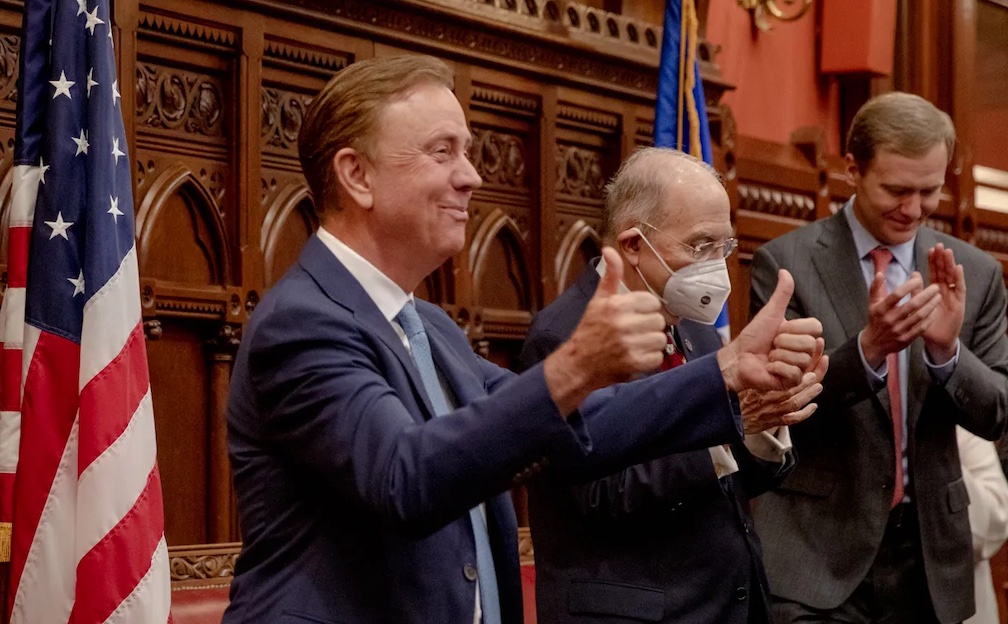
Gov. Ned Lamont opened his second term Wednesday by pronouncing an end to Connecticut’s chronic fiscal crisis, the long-ignored “elephant in the room” that he identified in his first inaugural four years ago as a destabilizing force in a state desperate for economic growth.
“Thanks to our collective efforts, the era of Connecticut’s permanent fiscal crisis is over,” Lamont said, pausing as General Assembly legislators on both sides of the aisle rose to applaud.
“It’s over. It’s over. It’s over as long as we maintain the same fiscal discipline that served us so well over the last four years,” said the Democrat, who handily won re-election in November.
While calling for continued discipline, Lamont insisted the state now can afford “a meaningful middle-class tax cut” that he did not detail Wednesday.
His tax and spending plans for the fiscal year that begins in July will be presented to the General Assembly next month.
Broad goals, few details
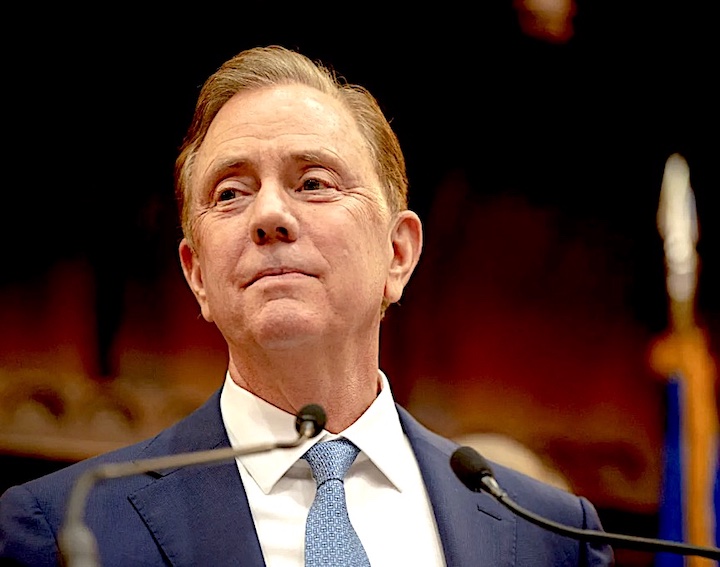
His speech was aspirational, not prescriptive.
Lamont challenged municipalities to work with the state to attack an affordable housing shortage that economists and business groups say is contributing to a tight labor market and an inability to fill 100,000 vacant jobs. He did not say how, but assured communities that he was not going to undermine local control.
The governor also challenged health care providers, health insurers and electric companies to join the administration in seeking ways to lower costs in their spheres, while offering no suggested path for them to follow.
Addressing the joint legislative session, Lamont was jocular at times, wistful at others and relaxed throughout.
He turned 69 the previous day, a milestone lawmakers recognized with a less-than-tuneful rendition of “Happy Birthday” as the governor entered the gilded Victorian-era chamber.
For a day, at least, the 89th governor of Connecticut was having fun.
Lamont noted that House Speaker Matt Ritter, D-Hartford, is 40, and Comptroller Sean Scanlon and Treasurer Erick Russell, each in their mid-30s, are Connecticut’s first millennials elected as constitutional officers.
Smiling, he promised that he and two contemporaries, Senate President Pro Tem Martin M. Looney, D-New Haven, and Senate Minority Leader Kevin Kelly, R-Stratford, “are hanging around to chaperone this party just a little bit longer.”
Lamont made clear he was aware a clock was already counting down on his second four years as the 89th governor of Connecticut.
“Thanks for the birthday greetings. I did turn 69 yesterday, all right?” Lamont said. “So time marches on. I feel like I’d better hurry up. Maybe I’m a little less guarded, a little more blunt. And I’m feeling a little more urgency to get to yes.”
Riding high after rough start
A month into his first term four years ago, Lamont proposed reimposing highway tolls as a step toward stabilizing a nearly insolvent special transportation fund that pays for the upkeep of roads and bridges and operations of commuter rail and buses. He never came close to getting the legislature to yes.
Ironically enough, Lamont was celebrating a transportation infrastructure victory Wednesday.
Between his speech in the afternoon and the inaugural ball in the evening, Lamont was scheduled to meet U.S. Transportation Secretary Pete Buttigieg in New London to celebrate Connecticut winning a $158 million grant for reconstruction of the Gold Star Bridge that carries Interstate 95 across the Thames River.
There was no mention of tolls.
Lamont’s anemic first-year approval rating surged once tolls receded as an issue and COVID-19 arrived. In March 2020, legislators went home, and the governor was free to largely govern by executive orders.
“Well, three years later, I still worry like heck about COVID,” Lamont said. “But I worry even more that we will lose the opportunity as a state, as a country, to lift families up. So the next four years should focus more on recovery and less on rescue, less need for lifelines and more focus on ladders.”
Growth goals, fiscal challenges as feds’ aid wanes
In short, Lamont warned that the subsidies and grants available from federal pandemic relief will come to an end.
If Lamont was clear that the lifelines will become shorter in his second term, he was less so about how and where ladders will be raised to opportunity.
“Keep our economy growing, making sure that growth means a ladder to opportunity for everyone, regardless of background, regardless of ZIP code. That’s what Connecticut is all about,” Lamont said.
Connecticut, of course, is very much a state of extremes and economic inequality.
In November’s election, Lamont, and many Democratic lawmakers, carried the cities and a surprising number of wealthy suburbs in Fairfield County and along the shoreline of Long Island Sound.
The economic and geographic diversity of the new Democratic base produced great victories in November, but it is likely to create conflict and challenge when it comes to tax and spending policies.

New spending vs. tax cuts
State Sen. Jorge Cabrera, D-Hamden, a labor activist who flipped a Republican seat two years ago, said he was most interested in seeing the state child tax credit extended this year, and he looks forward to figuring out the particulars of Lamont’s promised “middle-class tax cut.”
Cabrerra said the rising cost of health care, electricity, child care and housing made it essential to help lower- and middle-class families.
“I’m glad he’s finally come around,” House Minority Leader Vincent J. Candelora, R-North Branford, said of Lamont’s hints at a tax rate cut for Connecticut’s middle class. “It’s a little bit late, but any type of proposal to reduce the income tax, our caucus would come around to.”
House and Senate Republicans last year proposed cutting the 5 percent rate to 4 percent for all singles making less than $75,000 per year and all couples below $175,000 — which they projected would save many households about $750 per year.
But others are looking for spending increases, and Lamont will have to resolve his promise to simultaneously cut taxes, maintain fiscal stability and provide opportunities.
A coalition of labor, faith and civic groups, the Recovery for All Coalition, is pressing officials to dedicate more funding for health care, social services, affordable housing and education.
“As the wealthiest state in the country, Connecticut should be a shining example for the nation — a place where every family has what we need to live a good life,” said Puya Gerami, executive director of the coalition. “Instead, hundreds of thousands of working people are struggling to raise families here, while a handful of ultra-wealthy corporations and residents are getting even wealthier.”
The last time legislators eased rates on state income-tax payers came just four years after the tax had been established with a flat 4.5 percent rate on all earnings. The 1995 legislature then created a 3 percent rate, but it only applied to the first $10,000 earned by singles and $20,000 earned by couples.
Since then, the income tax has evolved in a system of seven tax brackets, with rates ranging from 3 to 6.99 percent, with most middle-income households’ earnings taxed at 5 or 5.5 percent. Any relief for filers since 1996 has come in the form of new credits and exemptions, many of which wax and wane with the state’s economic position.
Chris DiPentima, head of the Connecticut Business and Industry Association, said the governor “laid a good framework” in Wednesday’s remarks to the legislature.
Within that framework, Lamont was specific about some things, such as “maintaining the fiscal guardrail, which is certainly priority No. 1 for the business community,” DiPentima said. “Making sure the volatility cap, the spending cap, the revenue cap stay in place and aren’t deteriorating — that’s what’s given us the rainy day fund and the budget surpluses protected for the rest of this year.”
An inclusive tone: “These are Connecticut values”
The specifics of Lamont’s plan will come on another day. On Wednesday, he was intent on striking a tone of collegiality and inclusion in an era of sharp polarization.
He urged the lawmakers to make a greater effort to know and understand each other. He noted four of the 36 new legislators are foreign born.
“Thank you for making Connecticut your home,” Lamont said. “And that’s not woke. That’s America.”
His wife, Annie Lamont, was seated with Sara Niazai, who was resettled from Afghanistan in 2020 and is a student at Gateway Community College in New Haven. The governor said Connecticut is providing an educational opportunity denied to girls and women by the Taliban.
“If the Taliban doesn’t want you back to Afghanistan, you always have a home right here in Connecticut. These are Connecticut values.”
Lawmakers applauded.
Smiling again, the governor urged legislators to have fun at his inaugural ball, where the Bacon Brothers were to play.
“I want to see a little ‘foot loose’ on the dance floor,” Lamont said, offering a wry reference to one of Kevin Bacon’s movies. “Maybe with somebody you don’t know but you may see around the building every once in a while.”
Video of his own brand of dance, which relied more on enthusiasm than rhythm, went viral four years ago.
“I did get about 10,000 tweets saying, ‘Governor, never dance in public again.’ But it’s my party. I’ll dance if I want to,” Lamont said. “God bless the dancing state of Connecticut!”
CT Mirror staff writers Andrew Brown and Erica E. Phillips contributed to this report.










Recent Comments