
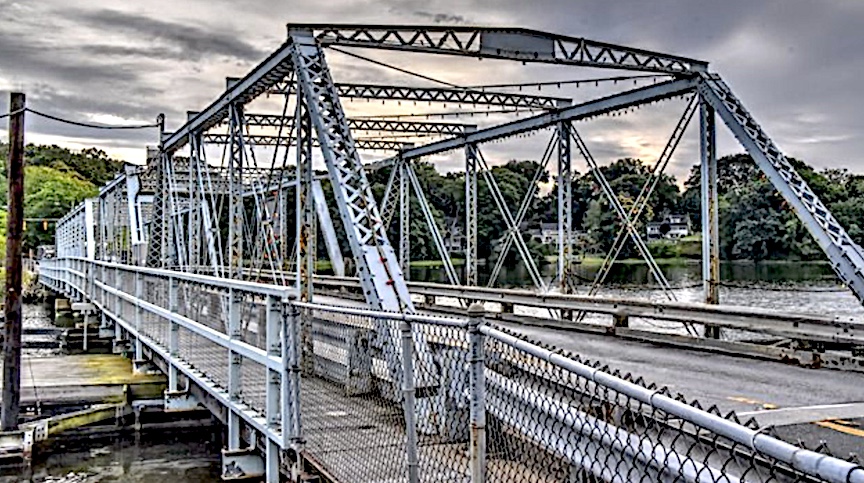
WESTPORT — State transportation officials Thursday revealed their preferred plans to replace the William F. Cribari Memorial Bridge, a 141-year-old metal structure spanning the Saugatuck River, with a new bridge costing $78-$80 million in its current location.
The Cribari bridge, a neighborhood icon and oldest moveable iron bridge in the state, also would be widened under the preferred, but preliminary, plans that were outlined at a meeting of the Cribari Project Advisory Committee convened in Town Hall.
The state Department of Transportation plan is described as, “Replacement of existing bridge with a new structure meeting minimum design standards in the same alignment as the existing bridge.”
Useful life of the new span is estimated to be 75 to 100 years, according to the DOT.
Currently, the bridge carries state Route 136 — locally known as Bridge Street — over the Saugatuck River. There is one travel lane in each direction crossing the bridge.
DOT representatives told the gathering that although the bridge would be widened, they feel truck traffic exiting Interstate 95 would be unlikely to use the route because of its “sharp curves.”
Neighborhood residents, however, reacting to various scenarios for the bridge over the years have cited an increase in traffic — particularly by trucks — as a significant concern if the span is widened.
(This is a developing story that will be updated later.)
The PAC Cribari stakeholder group — selected by the state to gather feedback from local official, neighbor, environmental and historical perspectives — was established in 2018. That followed several years of controversy that engulfed state plans to either repair or replace the bridge after the DOT in 2015 classified the span as “severely deficient” and in need of extensive repairs or perhaps complete replacement.
The group’s Thursday meeting was the first since 2019.

The DOT, in a statement released this week before the meeting, said it was “an opportunity for CTDOT to provide an update on the process and outline next steps. CTDOT wanted to be proactive and decided to re-engage the PAC since there are new members and provide an update prior to formal public outreach.”
The state said it plans to host a local hearing later this year — open to the general public — for more comments.
Long, controversial saga engulfed historic span
Thursday’s gathering comes after decades of debate over discarded plans to either relocate, repair or replace the bridge, which is the oldest metal swing bridge in the state.
A plan to move the bridge closer to Franklin Street was hatched — and dropped — in the 1950s, according to a chronicle of Cribari Bridge history by the Preserve Westport website. In the late-60s, there was a proposal for a fixed span — 60 feet high at its apex — with relocated approaches much longer and broader than currently in place. The plan was dropped a few years later in the face of local opposition.
Again, in the 1980s, controversy erupted between the town and state over replacing the deteriorating bridge. After concerted local pushback, an agreement was forged to preserve and repair the span. It was temporarily removed from service while a stand-in fixed bridge carried traffic across the river.
“Severely deficient” finding in 2015
The latest round of controversy, which set the stage for Thursday’s PAC meeting, has its roots in the DOT’s 2015 declaration that the span is “severely deficient.”
More heated debate ensued over the bridge’s future until 2017 when then-First Selectman Jim Marpe asked the regional planning agency to pull the plug on DOT’s request for bridge rehab/replacement funds until there was a comprehensive assessment of the project’s environmental impact and other factors such as community concerns about traffic, safety and history.
That, in part, prompted the DOT to create the PAC in 2018.
The reason for calling the meeting now, state DOT officials said in advance, was to update stakeholders after the regional planning agency last year agreed to restore $4.1 million for the right-of-way and final design phase for the bridge’s rehabilitation or replacement in its statewide transportation improvement plan, or “TIP” — essentially, the money that Marpe had blocked seven years earlier.






I attended the meeting reported on here.
The competent and polite engineers of CTDOT and assisting personnel were knowledgeable about the bridge but completely flummoxed by the plethora of questions and comments from the attendees. Old and retired Westporters (like me) were outnumbered by young Westporters who have chosen Westport to raise their young families and engage in the Westport community that has nurtured, educated, and nurtured its young for decades. There were no “obstructionists” there, no one was pining for lost glories… just residents voicing their heartfelt concerns about safety, pollution, overwhelming and dangerous traffic problems… all of which jeopardize their well-being and deserve to be addressed by elected officials.
Curiously, none of the municipal employees—head of Public Works, Police Chief, Fire Chief, etc. who were all invited—were there.
In reactivating the $4,100,00 funding for replacing the Willian F Cribari Bridge in January 2024 when she also offered a brownfields remediation remedy worth $12,000,000, the First Selectwoman unleashed the genie from the bottle. And it showed up in the Westport Town Hall auditorium on May 15, 2025.
The message from CTDOT was clear. Westport authorized us to replace the William F Cribari Bridge. Period.
According to the state, Westport has to allow every vehicle including 18 wheelers to use the bridge.
RESTRICTING TRUCKS IS WESTPORT’S PROBLEM.
The State of Connecticut has put the safety of Westport children whose busses stop 18 times a day on Bridge Street, the pollution of diesel truck exiting I-95 and idling on Greens Farms Road and Bridge Street, the potentially massive increase of WAZE traffic due to the lifting of weight and height restrictions completely and decisively into the Board of Selectwomen’s court. The Select Women’s Board is in charge of traffic—that’s the town charter.
With the Selectwomens’ advocacy of passage of the Hamlet’s P&Z application, the construction of the Hiawatha Project and who knows what the hell else we can expect (sorry I got agitated) how can Westport honestly welcome new families, insure them that a rational government is in charge of their safety and health, and pass on the sometimes wonderful, sometimes problematic experience of raising a family in Westport?
Werner, for the record, my associate Gretchen Webster, who attended and reported on the DOT meeting, notes that First Selectwoman Jennifer Tooker, incoming Police Chief David Farrell and Public Works Director Peter Ratkiewich attended the meeting.
I agree with Werner’s observations. Certainly the meeting’s atmosphere was one of respect. And the DOT team was friendly and polite. I think the latter genuinely believed its assertion that greatly expanding the bridge’s geometry would not have a material traffic impact. I also feel it’s fair to say that the audience understood what increasing the bridge’s carrying capacity (and thus the velocity of traffic) would really mean for local residents. This marks the sixth time the Cribari Bridge – documented to now be the nation’s oldest active pin-connected swing truss highway bridge, has been targeted for replacement by DOT. It won’t be the last. Things that matter require constant vigilance.