
By Thane Grauel
WESTPORT — The town held the latest in its series of community conversations on developing a five-year affordable housing plan Tuesday at Town Hall.
The plan is required under state law, and has be approved by June 1.
The forum began with a rundown from town officials on the status of the town’s current inventory of affordable housing.
Westport needs to attain 10 percent of its housing stock deemed affordable to qualify for a state-sanctioned moratorium that prevents developers from skirting zoning laws by using the state’s 8-30g statute. Currently, the town has about 3.75 percent of its housing deemed affordable.
That’s roughly 400 units of housing. About 700 more are needed to reach the 10 percent threshold.
The forums are designed to gather ideas on how the stock of affordable housing can be increased here.
First Selectwoman Jennifer Tooker thanked the crowd of about 40 people for attending.
She noted that the community conversations are not mandated by the state law requiring the five-year plan, but added they’re important for several reasons.
“First, it allows us as a leadership team, from the town, to make sure we reinforce the message that we are committed to diverse housing here in Westport.
“Second, it allows us to hear from you, from our community, our residents, what is important to you as we think about adding diverse housing to Westport.” Tooker said. “And lastly, what I think it does is reinforces from our standpoint how important local control is, and local decision making is on these issues.”
There was much discussion of deeply affordable housing, units that could be afforded by low-income families and individuals.
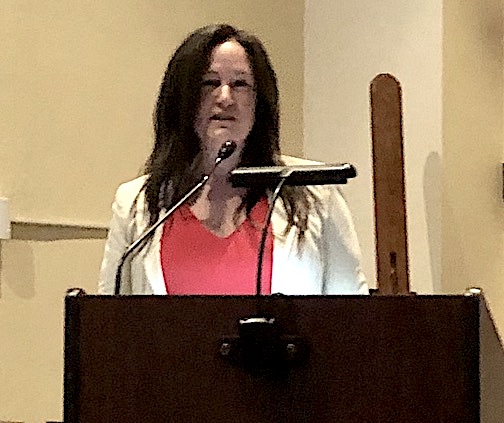
“I think the deeply affordable housing is going to require an injection of public funds, and if we are using public funds we really need to focus on the most efficient use of those funds,” Planning and Zoning Commission Chairwoman Danielle Dobin said.
Helen McAlinden, president and CEO of Homes for Hope, was among the speakers.
“I would like to just point out the need for deeply affordable housing,” she said. “It’s something that people who work in our shops, work in the town, really need.”
She said she recently heard some statistics about housing costs in Fairfield County.
“A person would need to earn $37.50 an hour in order to afford a studio or one-bedroom fair-market rent in Fairfield County,” she said. “And here in Westport it’s even a little bit more expensive.
She said that some people served by Homes for Hope work two full-time, minimum wage jobs at $13 an hour, and still can’t afford that amount for rent.
“I would really love for you to consider more deeply affordable housing in your plan,” McAlinden said.
“Are there any guarantees or priorities for Westporters to get into any affordable units?” asked Dick Stein.
“No,” Dobin said. “One of the ideas behind creating housing is to provide opportunities for people who are not residents to have opportunities to live here, but at the same time, open up more opportunities for people who are already here, to stay here.”
“I live in Westport,” said Sharon Wylie. “I got here all on my own. My odyssey from the South Bronx to Westport came with no assistance from anybody, and I don’t really like the government picking winners and losers.”
She said she didn’t like the idea of her paying market rate while someone else is subsidized.
“Westport is an aspirational town, it’s a town you’d like to live in,” Wylie said. “You don’t have a right to live here unless you can afford to live here.”
Kathy Ann Hart, who moved to Westport from a wealthy Massachusetts suburb, said she gave up law to become an actor, and makes many commercials.
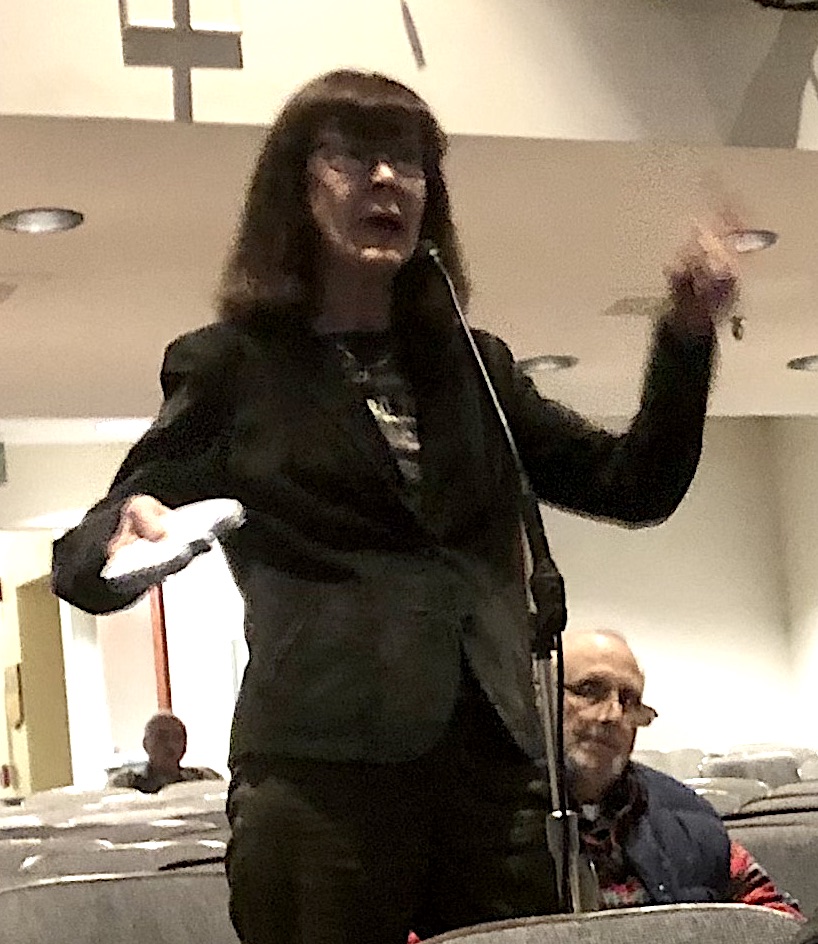
She wondered if there was a way to “encourage affordability and increase the number of housing units for artists to come here,” she said. “Like myself.”
Gerald Romano, a real estate agent from Saugatuck, wondered if the town’s infrastructure could handle hundreds more housing units.
“I don’t think our roads can handle it,” he said.
He also asked if the town’s sewage-treatment plant could handle the added volume of waste.








Every single effort to enforce the housing “affordability” issue has little to do with scarcity in Westport as much as it has to do with not permitting the re-use or re-purposing of the hundreds of housing structures in Westport, as well as all of Connecticut) that could be a valid 8-30g housing resource, that integrates with the look, feel and unique features of a CT town like Westport. This is a State and a Town with history of homes that were built from the 1800’s to 1989 That’s 189 years of choices we’ve been denied.
That’s why 8-30g begins only in 1990. Anything built before that date doesn’t qualify as 8-30g eligible. This was done deliberately. It wasn’t principle that created this CT Housing law, it was pure greed-driven profiteering.