
By Linda Conner Lambeck
WESTPORT–Westport ranks in the top 10 statewide in meeting or exceeding the expected state standard in science, but wants to do better.
A recent visit from the Tri-State Consortium, a group of high-performing school districts, laid the groundwork for what local officials hope will help strengthen how the subject is taught and enable students to become even better thinkers.
“Our goal is working toward continuous improvement,” said Assistant Superintendent Anna Mahon, who oversees teaching and learning for the district.
Mahon said the visitors’ critique matched conclusions already drawn by district officials
Tri-State Consortium report
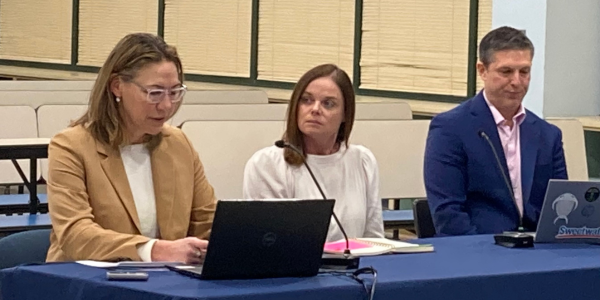
The group of 14 educators from Connecticut and New York, along with three Consortium staff members, spent three days in November visiting classrooms, reviewing curricula and talking with teachers, parents and educators.
Their subsequent report, reviewed by the school board last week, affirmed that the district has a strong and well-developed science program that is aligned with Next Generation Science Standards and which engages students with consistent hands-on learning.
“From a kindergarten lesson in a unit on weather where students were predicting how much water a sponge (cloud) could hold … to a high school AP Environmental Science lab where students were dissecting owl pellets … and drawing conclusions about the food chain, we saw students who were actively engaged …,” the report stated.
Students told the visitors science is fun. Parents could describe science lessons, like a fifth-grade Pizza Farm unit, that their kids came home raving about. Teachers talked about feeling supported.
Board Chair Lee Goldstein called the praise genuine.
Meeting with the visitors on their last day, Goldstein described the group as very impressed.
Mahon said a few members of the visiting team came wanting to learn more about the Westport system.
Next step: K-12 alignment
To step it up a notch, the group’s report suggests improving the alignment of the K-12 science curriculum, providing more professional learning for staff and more instructional time spent on labs and in-depth inquiries.
The group also wants the district to clarify where science sits among district priorities, said Kelly Michel, the district’s coordinator of elementary curriculum.
Reading and math may be the stars of the show, curriculum-wise, but thinking skills honed in science can benefit students across the curriculum, the board was told.
Rather than simply learning facts and subject areas, like biology and chemistry, science instruction today focuses on learning certain skills–such as asking questions, carrying out investigations, analyzing and interpreting data–that become more sophisticated as students go from elementary to high school.
As such, the state is not necessarily dictating what subject area is taught when, said Mahon. The focus is on the skill sets applied regardless of the topic.
“This iteration, in my opinion, is much stronger,” John DeLuca, the district’s 6-12th grade science coordinator, told the board.
It is helping students think like a scientist, Schools Superintendent Thomas Scarice said.
“Our challenge is to try to get better at it,” Mahon said.
District performance
In 2024-25, greater than 77 percent of Westport students met or exceeded the performance goals on the state science test given in grades 5, 8 and 11.
The district began a comprehensive review of its science program a year ago and has a committee of teachers who have been working to fill in gaps in the curriculum and broaden electives.
Throughout elementary school, students now keep journals to keep track of the concepts they have learned and earn badges for those mastered.
At the middle and high school level, there are certain assured labs and activities all students do, as well as common assessments. In an email after the meeting, Deluca told Westport Journal that there are about 45 science and STEM teachers in the district.
Over the next three years, Deluca said the plan is to create a new steering committee to strengthen the alignment of what is taught across the grades and develop greater consistency of practice.
The idea of creating more time for science will require a shift in scheduling which the board was told is part of a larger conversation of class scheduling already being developed.
At the elementary level, Board Member Abby Tolan suggested more time spent on science–and social studies–is not necessarily taking away from language arts and math if there is an interdisciplinary approach.
Regeneron Science Talent Search
Staples senior Nolan Francis was recently recognized as one of the top 300 science students nationwide in the Regeneron Science Talent Search. When asked about how the caliber of Westport’s science education was a factor in Nolan Francis’ recognition, Deluca said it “absolutely played a role in Nolan’s success.”
“Our program emphasizes authentic science thinking that challenges students to ask their own questions, analyze data, and persist through rigorous, open-ended problems. These are skills that are essential to building strong research students,” Deluca said. He also praised Francis’ teacher, Ms. Amy Parent, for pushing students “well beyond a typical class.”

Linda Conner Lambeck
Linda Conner Lambeck covers education for Westport Journal. She was a reporter for more than four decades at the Connecticut Post and other Hearst publications. She has covered education throughout Fairfield and New Haven counties. She is a proud member of the Education Writers Association.





Recent Comments