
By Linda Conner Lambeck
WESTPORT — Ask for a budget the school district needs or stay within town officials’ good graces?
That was the question Board of Education members wrestled with last week as the panel reviewed a 2024-25 budget proposal to forward for action by other town boards.
The board will decide Thursday whether to endorse or modify Supt. of Schools Thomas Scarice’s recommended $147.3 million budget plan for the next fiscal year, which is nearly 9 percent higher than spending this year. The board is scheduled to meet at 7 p.m. in Staples High School.
The increase would be closer to 3 percent higher were it not for a large spike in health-care costs.
“I have to recommend something that the board could put forward and continue a very supportive relationship [with town funding bodies] right now,” Scarice told the board when it met last Thursday. “I have to recommend a budget I feel the board can defend.”
As such, a list of about $1 million worth of administrative proposals did not make it into Scarice’s plan.
Topping that list is restoration of two elementary school assistant principal positions that would give the district’s five elementary schools two assistant principals each. Currently, only Long Lots has two assistant principals. The other four schools have one full-time and share two other part-time assistant principals.
Adding two assistant principals to the budget would cost about $430,000, the board would told.
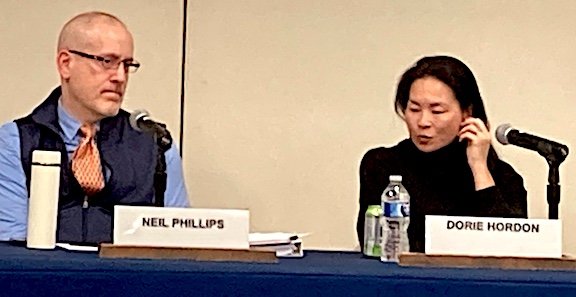
Board Vice Chair Dorie Hordon said it’s an expensive ask, but also meets the gold standard when it comes to providing staff that allows principals to focus on instruction and students an additional trusted adult to handle the administration of special education, bullying investigations and other tasks.
Board Chair Lee Goldstein said she agrees with the important roles of assistant principals. but questioned adding the expense in a year when health-care costs are expected to be so high.
“Every budget is hard,” Hordon responded. “There is never going to be a budget year where we say things are great … It comes down to what we value in the district and what our priorities are.”
Board Secretary Neil Phillips said one of the reasons the board has had a successful run the last two or three budget cycles is that it handed in a budget he called responsible.
“I think that made a difference,” Phillips said. “I am not saying this will change that. It may pass. We could ask for everything [on the list of items cut].”
A better strategy, Phillips suggested, may be to let town officials know the school board is committed to eventually restore the assistant principal jobs, which had been in place until a few years ago.
Board member Robert Harrington said it is not the current school board’s fault that prior boards did not address mounting issues or that health-care costs are so high.
“That shouldn’t have an impact on the way elementary school is structured,” said Harrington. He called adding the assistant principal jobs the right thing to do.
“We should have confidence to say this is what we need in the classroom,” Harrington said.
Hordon pointed out that discussion of restoring the positions has arisen over the last several budget cycles.
From the audience, former Representative Town Meeting member Harris Falk said he agreed with Hordon.
Including funds for the extra assistant principals will at least force town funding bodies to discuss the issue, he said.
Ultimately, Goldstein pointed out, town officials have no line-item control and only approve the district’s budget total.
Trade-offs
Some time also was spent during the meeting discussing possible cost-cutting moves that might offset the additional assistant principals.
The board was told the idea of centralizing the district’s modest elementary gifted program to one or two schools would not be cost effective.
The same was said about middle school clubs. Stipends for club advisors between the two middle schools amount to a budgeted $314,557, the board was told.
A look was taken at possible school and town partnerships to cut costs.
Chief Financial Officer Elio Longo said a study commissioned three years ago found that efforts to combine payroll, human resources, business administration and financial management would not result in a reduction of staff or increased efficiencies.
“There would be drawbacks for both,” Assistant Supt. John Bayers said.
The administration also looked at possible course reductions at Staples High School. Some have already occurred.
Given a state and nationwide teacher shortage, the board was told to be careful about any further staff cuts at the high school level, where enrollment is expected to start increasing in a year.
Transportation efficiencies remain a work in progress as well.
A four-day head count of student ridership showed on any given day about 2,000 students ride buses to school. There are seats for 4,700 students.
Bus 18 to Staples High School in the morning has 45 seats. One student rode the bus each day to school last week, the board was told. That bus then heads to Bedford Middle School, where ridership picks up to 58 percent in the morning and 69 percent in the afternoon.
Moving the lone Staples student on Bus 18 to a different bus could save some money, but could also mean a longer bus ride for that student.
Administrators said they will continue to track ridership.
Goldstein said opportunities for savings appear to be something that may come with the next budget cycle.
Health insurance costs also are not nailed down.
At the moment, the 45 percent increase Aetna told the district to expect is penciled into the budget proposal.
Longo said Aetna has since brought that increase down to 40 percent, which could shave $800,000 — or 0.6 percent — off the district’s proposed budget.
That comes as a town and board working group continues to consider returning to a state partnership insurance plan. That could save $2.5 million, but would also involve a three-year commitment. That could cut the proposed increase by 1.5 percent.
Freelance writer Linda Conner Lambeck, a reporter for more than four decades at the Connecticut Post and other Hearst publications, is a member of the Education Writers Association.








Dealing with escalating costs is never easy. However, the reality is that the rising health care costs must be offset, at least partially. The BOE cannot just ignore this cost for taxpayers who are likely facing similar budgeting dynamic in their own households or businesses.
The schools should be held to responsible budget limits. The BOE must find ways to hold the line. It won’t be easy.
The bus ridership issue must be better managed also. Only a third or less of Long Lots students ride the buses to/from school. I suggest stronger incentives for bus ridership, such as restricting the times for individual drop off/pickup to after buses have been discharged; giving students who ride the bus an appealing “perk” during the school day such as extra play time; and better educating parents on the inefficiencies and unnecessary costs associated with their behavior.
Is there a study available that assesses LLS bus use as you state above? Could you please provide the link? I would be interested to see the results of all elementary bus ridership compared pre and post the change of the school start times. Unfortunately, bus ridership at the elementary level is highly determined by the restrictions created when the school start times were moved back. Meaning elementary school kids aren’t CHOOSING not to utilize the bus, but rather they cannot take the bus and make it to after school activities on time.
Creating a system to penalize those kids and families (who now have to add an extra pick up from school by the way) doesn’t seem fair or appropriate.
It sounds to me like looking at a single student riding a bus to and from Staples is a much more valuable use of resources then “a third or less” of one single elementary school students.
I assure you as a parent of 3 children in a dual working household with full time child care – this is not a chosen ‘behavior,’ but rather a necessity created by the fact that our elementary school start and end times are so late. It takes two out of the three adults in our household to manage the afternoons, and that is usually with at least one child still riding the bus on a given day.
This is a study being conducted by the school district. It was discussed at the BOE last week. The school CFO Elio Longo has the data. He read out preliminary data at the meeting and I took notes. I do not know if the administration will post this data but you can ask for it. Incentives for bus ridership was also suggested by BOE members. Providing bus transportation is a huge expense for taxpayers. This is all part of the school budget discussion.