
By Linda Conner Lambeck
WESTPORT — Staples High School, which prides itself on offering students an abundance of courses, has slated 235 this year, not including online or independent learning experiences.
In the next school year, that number increases to 238.
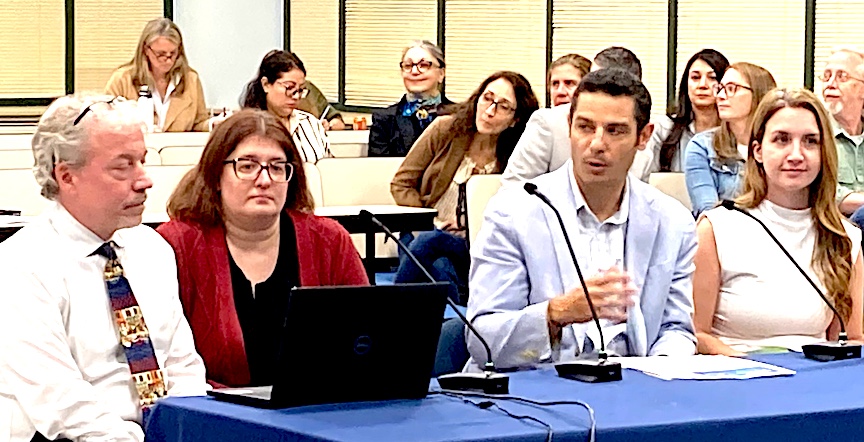
The Board of Education was given a preview of the three new courses last week, and the opportunity to ask questions.
The new offerings include an accelerated math course that combines Algebra 1 and Geometry, a year-long, advanced forensics course and a Spanish Films Studies course geared toward seniors who have exhausted the sequential Spanish courses now offered by the district.
“These offerings are designed to deepen student engagement, promote critical thinking and equip our learners with skills relevant to today’s world,” Supt. of Schools Thomas Scarice told the board. As a bonus, the three new classes are not expected to require additional staff, only modest instructional materials or equipment, the board was told.
The sum of Algebra I and Geometry
Most students who hope to reach calculus at Staples must prepare for the course in middle school. Otherwise, they must take both year-long geometry and Algebra II courses at the same time at Staples, or sacrifice time and money by taking summer math courses.
Starting in the fall, however, students who suddenly discover an acuity for math — at a teacher’s recommendation only — can take a new course designed to give them both a robust understanding of algebraic concepts and geometric principles.
The course will run for two periods in the first semester and one semester in the second.
“This course offers a new on-ramp,” said John Wetzel, a Staples math teacher.
It is anticipated the course could have an initial enrollment of 14 to 17 students.
Assistant Supt. Anthony Buono said the new course would not skip material, but deliver information in an accelerated format. Those who can’t keep up will be able to drop the course early in the first semester.
Nicole Giuliani, another math teacher, said she has had students interested in such course so they can reach calculus by senior year without devoting four hours a day during the summer to take an intense, accelerated course.
In addition to algebraic concepts, the course will cover linear functions, linear systems and exponential functions then blend them together.
Calum Madigan, a Staples senior and student representative to the school board, said he likes the idea for the course.
“I always found it unfair that eighth grade determines your path in high school,” said Madigan.
Board Chair Lee Goldstein said the course is consistent with the district philosophy that students develop at different times.
Board Vice Chair Dorie Hordon sought assurances that students won’t miss foundational learning in the subjects that could hurt them in the future.
Stacey Delmhorst, a math teacher, told the board they would not. The pace is simply faster.
Stefan Porco, math coordinator for the district, said Wilton also offers a combined Algebra and Geometry course, but in a different format.
The board asked to be apprised of how the course goes.
Crime solvers: forensics advanced
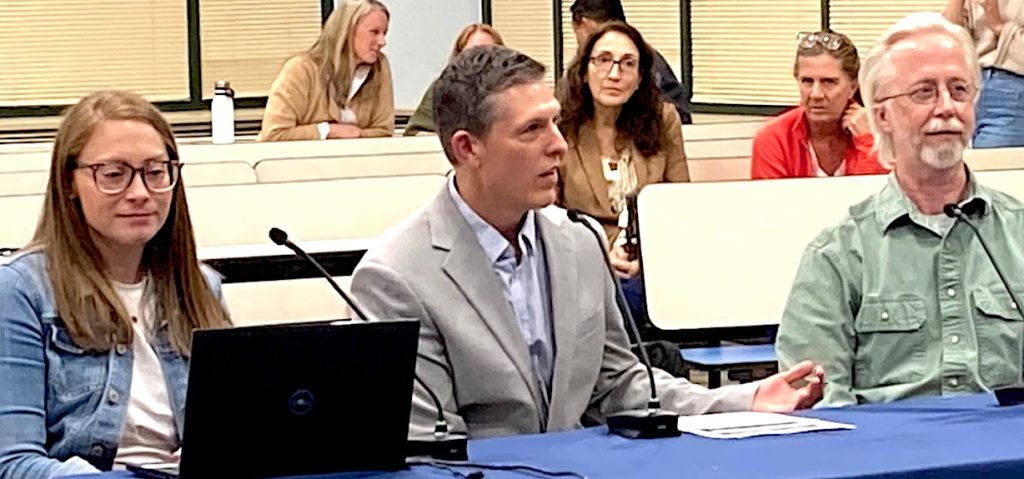
Staples already offers a semester-long forensic science course. The one introduced next fall will go beyond dusting for prints and looking at blood splatters to delving into superglue fuming, using trigonometry in blood splatter identification and exploring drug, alcohol and poison detection. DNA analysis will also be introduced.
Students love solving problems, said John DeLuca, chair of science at Staples. He anticipates the course could attract as many as 100 juniors and seniors yearly looking to fulfill science or STEM graduation requirements.
A key component will be a final crime scene and mock trial project where students will use what they have learned to solve a simulated crime.
The Staples science department will collaborate with the FBI, Connecticut State Police, Chief Medical Examiner’s Office and other law-enforcement agencies and is working with Southern Connecticut State University to possibly offer the course as an early college experience that could come with college credits.
Like the math course, the new offering would require no additional staff, but some equipment will have to be purchased, the board was told.
Estudios de cine Español
Until now, world language courses offered by the district have been sequential in nature with few “electives.”
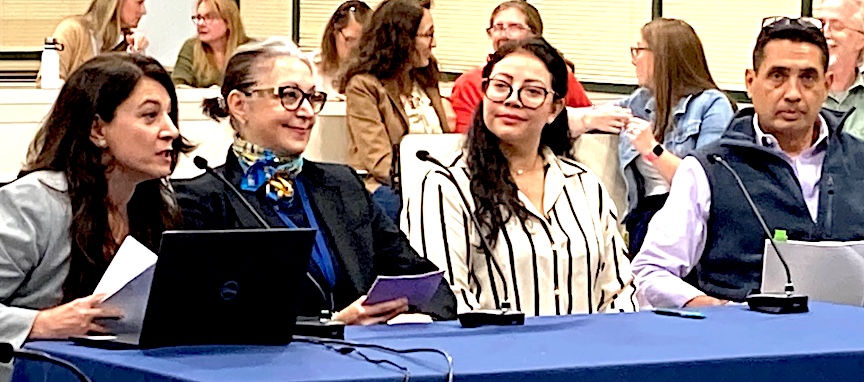
Maria Zachery, department chair for world languages, said the new offering grew out of a need to offer students who have completed Spanish 5 to take a course in senior year besides the very challenging Spanish literature. “You have to really like literature” for that offering, said Zachery.
A handful do, but the department believes as many as 105 juniors — four or five sections worth — would be willing to hone the Spanish skills they have spent years learning by exploring the cultural, historical, political and social issues in Spanish films from around the world.
Zachery called it a capstone course.
Joe Barahona, a Spanish teacher, said students would not spend class periods watching full movies, but clips that they would then talk about in Spanish.
Films, Barahona said, lend themselves to having conversations where there are no right or wrong answers, merely opinions that students would have to back up.
Zachery said the new course aligns not only with district goals but with new state language standards that are coming down the pike.
Madigan, the board’s student rep, said he didn’t take the Spanish literature course because he didn’t feel prepared, but would have taken a course that involved movies for greater exposure to Spanish cultures.
Depending on how fast the spoken dialogue is, that may not be a correct assumption, he was told.
Freelance writer Linda Conner Lambeck, a reporter for more than four decades at the Connecticut Post and other Hearst publications, is a member of the Education Writers Association.





Recent Comments