

By Linda Conner Lambeck
WESTPORT–A four-hour primer on how the district plans to embrace the use of Artificial Intelligence in the classroom this fall left most members of the school board feeling overwhelmed.
“Have you taken on more than what can feasibly be done,” asked Board Secretary Neil Phillips at a meeting last week.
“This is a big haul,” said Board Vice Chair Dorie Hordon.
“Is there any concern this will impact cognitive learning,” added Board Chair Lee Goldstein.
And with so much manpower devoted to AI, what other important things are being neglected, asked Board Member Abby Tolan.
Schools Superintendent Thomas Scarice agreed what was presented–the culmination of 18 months of study by district officials–was a lot.
“It’s a significant shift,” Scarice told them, while insisting that the district has the bandwidth to harness the power of AI while maintaining a human-centered approach to teaching and learning.
Scarice called it one of the most important initiatives of his career.
With AI increasingly becoming a tool students use for schoolwork at home anyway, Scarice said the district has no other choice to make the topic a focal point of its strategic plan.
In plain language
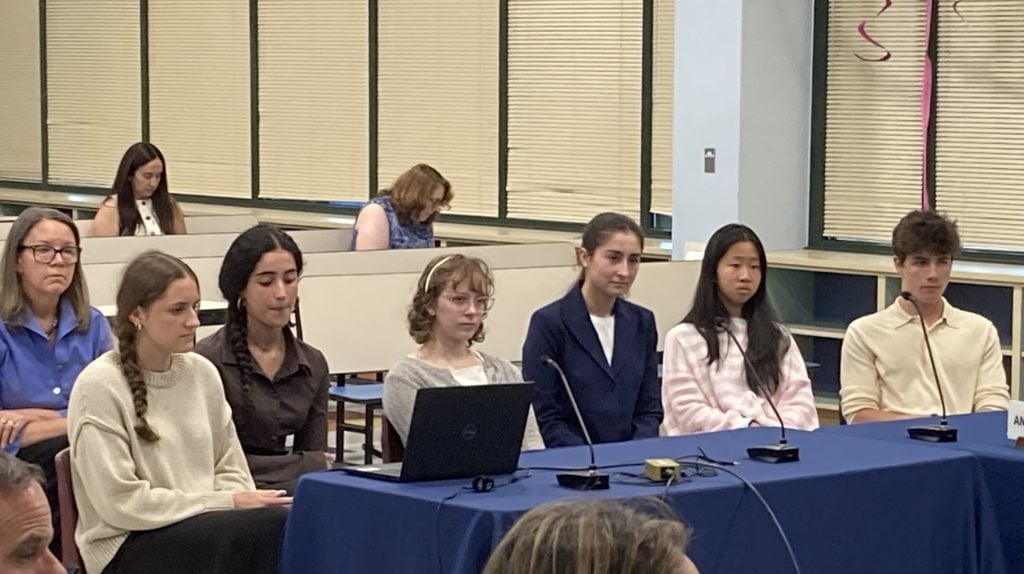
The presentation began with the board being wowed by students in Amy Parent’s honors-level Scientific Research class at Staples High School who were able to explain simply how AI helps to further their research and thinking, not supplant it.
Sienna Schwartz, a Staples junior, called AI a thought partner as she investigates new ways to battle microplastics.
AI, Schwartz said, helped her to narrow her research topic more efficiently as she combed through tons of data.
Junior Elise Yan said she used AI to generate animation to simplify her complex research topic on breast cancer research.
Freshman Lily Bottner said she knew a lot about climate change but very little about coding. AI helped her sift through more than 100 videos to get to the raw data she needed to advance her study.
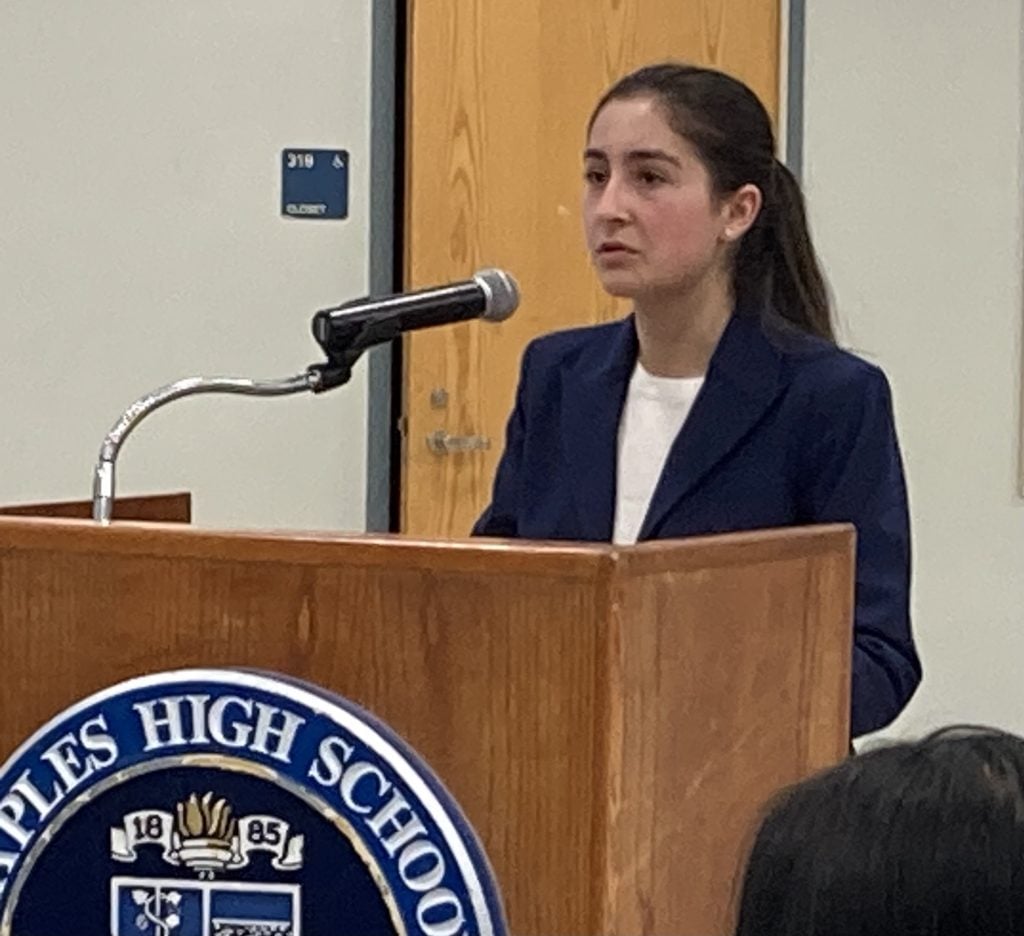
Sophomore Serena Diamond credited AI with helping her win second place in the Connecticut STEM fair for a project called A Direct Comparison of Vision Transformers (ViT) and Convolutional Neural Networks (CNN) for Exoplanet Transit Classification. AI helped her focus on the design and science behind her project rather than the nitty gritty of coding, she said.
“This would not have been possible without the use and partnership of AI,” Diamond said.
Hordon asked the students how they know if AI is giving them the correct answers.
The students told her through factchecking.
“Understanding it could be wrong is vital,” Ezra Schwartz, a graduating student and member of the research class, told Hordon.
“Everything has to be …sourced,” said Parent. “Learning that fact checking skill is absolutely critical to this process.”
Academic integrity
District work on AI has been broken up into committees.
John Bengston, a Staples social studies teacher, led the effort to incorporate AI into the district’s Academic Integrity Policy.
Color-coded guidelines have been established at the middle and high school level that set ground rules for the use of AI for any given assignment.
Green means students can use district-approved AI tools to do an assignment. Yellow allows for controlled use of AI. Red means AI is not permitted for certain tasks.
Several board members liked that idea.
Beyond the honor system, the board was told that in more cases, students will be asked to show their work and provide rough drafts and bibliographies for assignments.
AI Literacy
Another group of teachers worked to draft what AI skills will be taught and when, starting in the elementary grades.
Assistant Superintendent Anna Mahon said the goal is to build a staircase of skills that protects student privacy, demystifies the technology and establishes clear boundaries for when not to use AI.
At each grade level, the framework covers the same areas in increasing complexity.
“Where is this time (for the new learning) coming from,” Goldstein asked.
“It is an extension of what we are already doing,” in many cases, Manon said.
Many skills will be integrated into current lessons.
There could be a stand-alone course in AI literacy at the high school level.
Scarice said that has yet to be decided.
This summer there will be some curriculum writing and professional development.
Board members said they liked that the literacy committee developed a glossary of AI terms to help everyone understand the vocabulary involved.
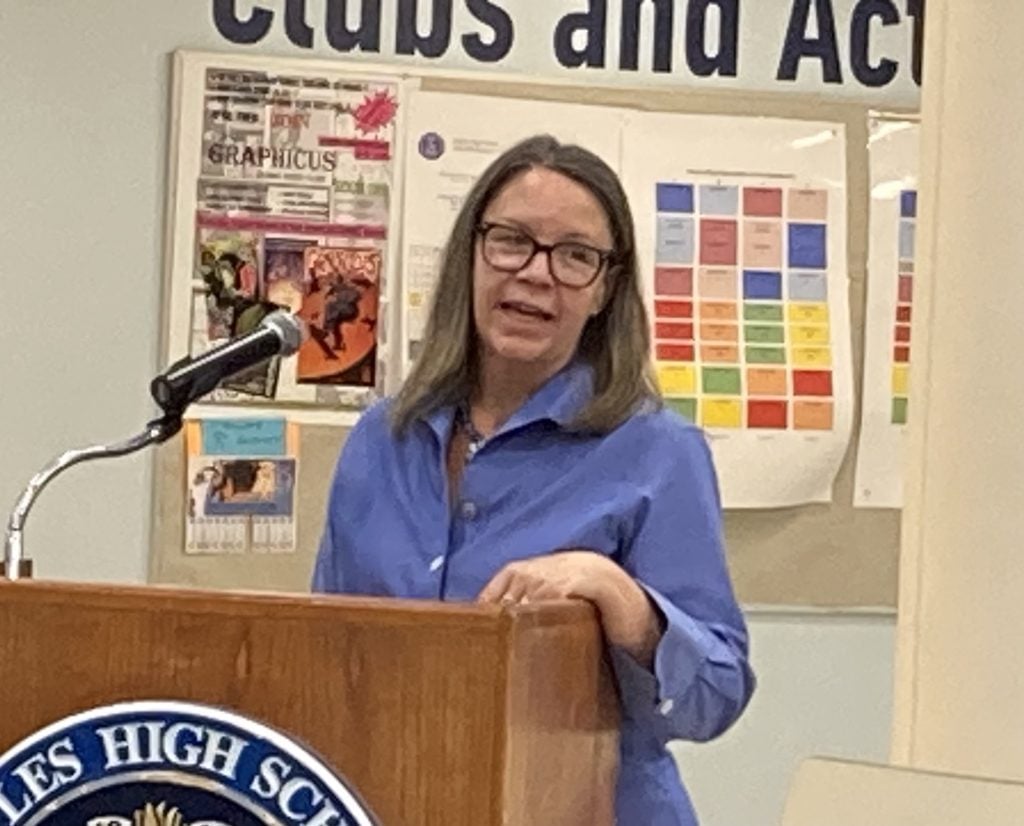
To further explain how AI will be used, Scarice said there will be a parent seminar featuring Casey Cuny, the 2024 California Teacher of the Year, on Monday, June 22, at 7:00 p.m. at The Westport Library.
“Raising AI-Ready Students: Learning, College, and Careers in a Changing World” will explore how AI is already reshaping how students learn and study, and how parents can help.
Board Member Jill Dillon asked how the AI plan jives with a board desire to limit screen time for younger students. A plan to discuss a recent district screen time audit at the meeting, was pushed off until the next week when the AI discussion went on so long.
Piloting a specific tool
This spring, the district piloted the use of NotebookLM, which allowed students in a single biology class to feed specific curriculum materials, notes and web sources into a data-privacy compliant AI tool to help synthesize complex information and personalize learning.
When complete, the district will determine if the tool shortcuts the learning process, helps support learning styles of students with special needs and if there is any loss in human connection between students and the teacher through its use.
District Technology Director Natalie Carignan likened NotebookLM to other tools like ChatGPT or Gemini. Designed by Google, it allows users to set up the sources it wants to be used rather than scour the Internet. It can create podcasts, flash cards and other means to help students study.
It is also free to use.
When NotebookLM became available some schools just turned it on, Scarice told the board. Westport decided to pilot it first.
Figuring out the right way
Scarice said while AI can replace thinking, he also thinks there is emerging research to show it can also be used to elevate thinking if done the right way.
Hordon asked what the plan was for evaluating what the district plans to do.
She also wants to know how comfortable teachers feel in using AI more broadly in the classroom.
Carignan said there will be surveys of both kids and teachers.
Mahon told the board the topic does feel massive and overwhelming but that the district, to her knowledge, is the only one taking such a systematic approach to AI.
“We are the only school district that I know of that is doing it this way,” Mahon said. “We are committed to it because we think it’s the right way.”

Linda Conner Lambeck
Linda Conner Lambeck covers education for Westport Journal. She was a reporter for more than four decades at the Connecticut Post and other Hearst publications. She has covered education throughout Fairfield and New Haven counties. She is a proud member of the Education Writers Association.






Recent Comments