
By Thane Grauel
WESTPORT — Depending on where you live or who you ask, it’s either an ecological terror or a tasty meal.
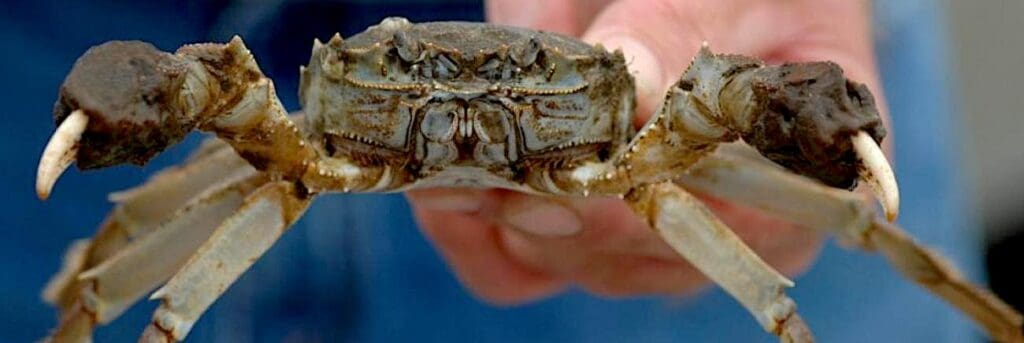
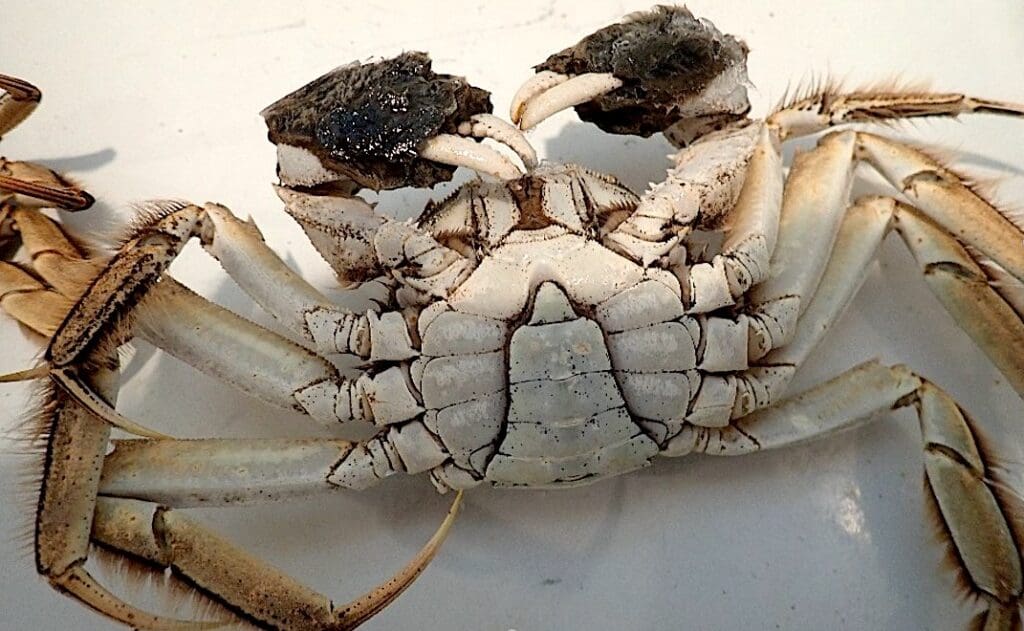
Meet the Chinese mitten crab, one of Westport’s newest residents.
The invasive species was found in Deadman Brook on the downstream side of the Myrtle Avenue bridge. The flood-prone waterway meanders through town before feeding into the Saugatuck River just east of the Levitt Pavilion.
Just a few estuaries in Connecticut have had sightings of this crusty critter from afar.
According to the state Department of Energy and Environmental Protection, the mitten crab was first seen in Connecticut in the Mianus River in Greenwich in 2012, then New Haven Harbor in 2019, and in the Housatonic River at Milford, Stratford and Derby beginning in 2020.
The Hudson River, Chesapeake Bay and San Francisco Bay have recorded numerous sightings, as have countries around the world.
Delicacy vs. destroyer
The crab is a delicacy in China, but has caused damage around the world.
Richard Harris, founder of Harbor Watch at Earthplace in Westport and now a marine scientist for Copps Island Oysters in Norwalk, said the concern here is that the crabs can multiply quickly, and burrow into mud, undermining earthen structures.
That happened in Germany, Harris said.
“On the Rhine River, they caused hundreds of millions in damage,” he said.
How the crustacean’s presence here will play out, Harris said, has yet to be seen.
Connecticut has had no shortage of invasive species in recent years, from tree-killing beetles (ash trees are mostly gone over the last few years) to virus-spreading mosquitoes and crop-threatening moths.
Mitten crabs likely came to the U.S. through restaurant smuggling and in the ballast of ships.
Mayhem can follow mitten crab invasion
“Chinese mitten crabs can damage fishing gear, clog pumps and in-take pipes, cause riverbank erosion through their burrowing activities, and outcompete native species for food and habitat,” states the state DEEP website, where there is information about other most-wanted species, ranging from water chestnut to something slimy called rock snot.
Mitten crabs, the website notes, “are relatively new to the Atlantic coast, however, and at this time it is unclear as to what their effects will actually be here.”
Connecticut has no native freshwater crabs, so any sightings should be investigated, officials say.
Shelling out for smuggled cargo
Harris said the crab is a prized delicacy, each one can be sold to restaurants around the world at $30 each. A smuggled shipment of 3,700 mitten crabs was discovered in Cincinnati last January, Harris said, in boxes of tee-shirts. The crabs were wrapped in seaweed and destined for New York.
Harris said that in China, people can buy live mitten crabs in vending machines, wrapped in seaweed and including condiments.
And they know how to skedaddle. Harris said they’re escape artists and prolific egg layers.
He said they have a few predators in salt water, including black bass, black sea bass and stripers. But in fresh water, they are prey mostly for just raccoons and humans.
The mitten crab found by Harbor Watch in Deadman Brook, he said, was dead, and about two inches across the carapace (main shell).
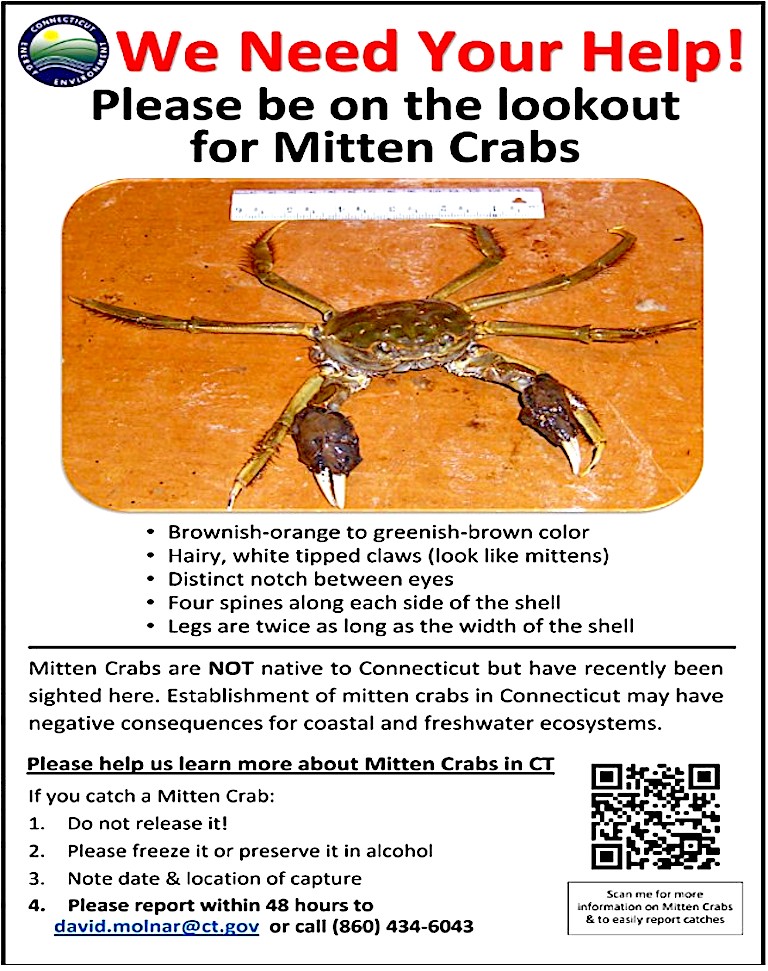
The crabs, ranging in color from brownish-orange to greenish-brown, are named for their fuzzy claws and live in fresh water. However, they head downstream to salt water in late autumn to reproduce, Harris said.
Of those captured in the Housatonic, he added, “The last three crabs were pregnant females. They’re good for a million eggs each.”
Keeping track of invaders
What should you do if you think you’ve come across a mitten crab?
The DEEP says don’t release it. Freeze it or preserve it in alcohol. Note the date and location of its capture. Report the finding within 48 hours to david.molnar@ct.gov or call 860-434-6043.
Sightings can also be reported on the DEEP’s online reporting app, the Marine Aquatic Invasive Species Survey (MAIS Survey).












Thanks for providing this important information.