

Cate Blanchett delivers a powerhouse performance as an acclaimed concert conductor/composer in Todd Fields’ revelatory “TÁR.”
Our first glimpse of Lydia Tár (Blanchett) is a tall, slim, confident woman, stylishly dressed in a black suit and crisp white shirt, luxuriating in her celebrity while preparing to take the stage in Manhattan for a New Yorker talk with writer Adam Gopnik (as himself).
American-born Tár was a Leonard Bernstein protégée who became the first female principal conductor of the Berlin Philharmonic in 2013. Refuting claims that she was ever held back by gender bias, formidable Tár went on to achieve success with the world’s most renowned orchestras, along with winning an Oscar, a Tony, an Emmy and a Grammy.
(I wish I knew more about the classical music world because I was mesmerized by the way in which she is meticulously preparing to perform Mahler’s Symphony No. 5.)
At lunch with Eliot Kaplan (Mark Strong), whose generous investments have enabled her Accordion Conducting Fellowship for young woman, Tár adamantly refuses to allow him to see her Mahler’s Fifth notations, curtly dismissing his request with: “Do your own thing. There’s no glory in being a robot.”
Imitative or robotic thinking so annoys Tár that she flamboyantly eviscerates a Julliard student in a Master Class, a rash condemnation that will come back to haunt her.
That – along with allegations of reckless sexual misconduct with various subordinate female musicians, one of whom committed suicide – contribute to Tár’s eventual downfall – particularly when she suddenly turns her attention to Olga (Sophie Kauer), giving the sexy Russian cellist a solo in Elgar’s Cello Concerto.
Dutifully attended by her assistant, Francesca (Noemie Merlant), an aspiring conductor whom she mentors, Tár identifies as “a U-Haul lesbian.” She lives in a Berlin apartment with her partner Sharon (Nina Hoss), concertmaster and first violinist; they share an adopted daughter, Petra (Mila Bogojevic).
In developing this project, actor-turned-writer/director Todd Fields (“In the Bedroom,” “Little Children”) focuses on the concept of power and what having it does to a proven predator, touching on identity politics and cancel culture.
“If the story was about a white male, you’d know how to feel in five seconds,” Fields told the Hollywood Reporter. “But it was important to try to figure out another, more nuanced way to examine power itself.”
On the Granger Gauge of 1 to 10, “TÁR” is a provocative, intriguing 8; it is available-for rent or purchase-on Google Play, iTunes, Amazon Instant Video, and Vudu. It is streaming on Plex and Tubi.
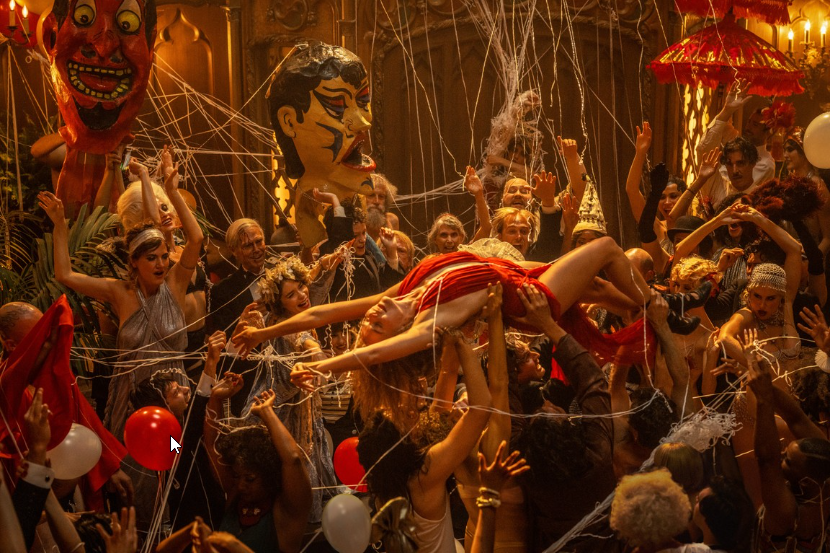
“Babylon” is a grotesquely graphic, three-hour mess of a movie about early Tinseltown!
Focusing on an era of decadent depravity that is the antithesis of his musical fantasy “La La Land” (2016), writer/director Damien Chazelle’s saga begins in the Roaring 1920s as Manny Torres (Diego Calva), an ambitious Mexican production assistant, navigates the tortuous hills of Hollywood to deliver a ‘live’ elephant to an extravagant, coke-fueled Bacchanalia, a messy job that doesn’t end as expected.
Choosing several tawdry tales from Kenneth Anger’s muck-raking expose “Hollywood Babylon,” Chazelle quickly segues to a thinly veiled glimpse of the rape scandal that ended actor Fatty Arbuckle’s career before introducing Nellie LeRoy (Margot Robbie), a frenzied, flamboyant starlet evoking memories of uninhibited Clara Bow, who became known as the amoral ‘It’ girl.
Jack Conrad (Brad Pitt) is a composite matinee-idol based on Douglas Fairbanks, Rudolph Valentino and obviously John Gilbert, whose career as Hollywood’s highest-paid actor was torpedoed by the advent of sound since his soft voice didn’t match his swashbuckling on-screen persona.
Then there’s jazz trumpeter Sidney Palmer (Jovan Adepo), inspired by Black bandleader Curtis Mosby, and Lady Fay Zhu (Li Jun Li) as the thinly veiled lesbian icon Anna May Wong. Plus Nellie’s opportunistic father (Eric Roberts) and a seedy mob boss (Tobey Maguire).
These lavish vignettes are duly chronicled by newspaper columnist Elinor St. John (Jean Smart), drawing on the early gossip-writing careers of Louella Parsons and Hedda Hopper. Which inevitably led to Hollywood’s 1934 self-censorship agreement, known as the Hays Code, setting a strict moral tone, banning on-screen nudity and drug taking.
Too bad the over-the-top craftsmanship of cinematographer Linus Sandgren, production designer Florencia Martin, costumer Mary Zophres, editor Tom Cross, and composer Justin Hurwitz is simply squandered.
FYI: The Babylon concept can be traced back to D.W. Griffith’s epic silent film “Intolerance” (1916). And apparently, there’s a two-hour script rehearsal that Chazelle shot on an iPhone with him, his wife (Olivia Hamilton) and Diego Calva playing every role. Perhaps it’s better.
On the Granger Gauge, “Babylon” barely musters a flashy, fatiguing 4. If you’re curious, wait ‘til it’s streaming.




Recent Comments