
To the editor:
Last night’s Board of Finance meeting started at 7:30 p.m. and ended sometime after 1:30 a.m. this morning. The meeting was about a single item — Construction of the new Long Lots Elementary School.
These were six long hours of discussions revolved primarily around the narrative that the athletic fields are more important to Westport than community gardens, not ever considering that the site can accommodate both. In fact, the narrative by the Long Lots School Building Committee has been that the school and the multi-use fields can’t be safely and economically constructed while keeping the gardens in place.
There were many points of this narrative that I could challenge, but for the sake of time and space on the page, I will stick to only two.
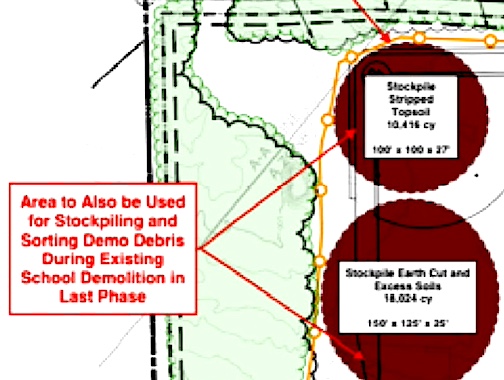
1. The picture (at left) shows material staging over the gardens as presented to the board and the public. The smaller stockpile is designated as topsoil and the larger one, as excavated material including excess. Also, the note to the left states that during demolition, the same area would be used to stockpile and separate construction demolition debris prior to disposing it off-site.
Anyone who built anything knows that stripping of topsoil is one of the first steps in the construction sequence and re-spreading it is one of the last ones when the site is being restored post-construction. The construction manager was asked by a board member, why would you stockpile excess material? The CM responded that this excess material would be used for final site grading. Again — final.
Also, during the presentation the same professional “piled on” about the cost savings associated with storing other materials in the same location. In all, he presented the cost savings of $5-6.7 million! It is obviously impossible to store other materials while the area is occupied by soil stockpiles. The saving from not trucking topsoil and excavated materials off site and trucking it back when needed, would be a few hundred thousand dollars, not millions and a lot less than the cost of destroying and then rebuilding community gardens.
2. The School Building Committee also presented a benchmarking table comparing the costs and sizes of the proposed Long Lots School to five school projects recently completed by their construction manager.
While the Board of Finance justifiably questioned the independence of this comparison, what struck me was the “square feet per student” ratios in this table. Every elementary school in this table had a lower ratio than the proposed Long Lots Elementary School. Why does LLES need more space than its peers? Is it because of a non-efficient design of the school building or the overstated design criteria? I don’t know, but we are talking about 15-20 percent of $100 million.
These issues and many others like them underscore the need for a competitive bid process. To preempt this concern, the school building committee assured the public that there will be another RFQ to procure the next phase of design and construction management services. Request for Qualifications, the RFQ, is not an objective competitive process; one can simply select the current consultants on the premise that they are the “most qualified.”
What is needed is a competitive Request for Proposal process that would allow professional firms to compete on price as well as ideas. The proposers should be tasked to come up with a solution that keeps all current stakeholders on site while meeting the needs of our children educationally as well as athletically. And let’s not forget all of us — the taxpayers.
It is a common industry practice to seek competitive bids on combined design and built, thus assuring the best value. I recommend that the Town of Westport seriously considers this option. This project is too expensive and too ethically sensitive not to.
Yulee Aronson
Westport








Douglas Enslin recently shared the cost of the recently built Cranberry School in Norwalk vs. the recently proposed estimate for the replacement of the current Long Lots School. Hmmm….as someone with almost 40 Years of commercial construction experience as well…one does not have to “dig deep”…no pun intended to determine that this is an extremely flawed process. No one is listening to Yulee who has taken a considerable amount of personal time to analyze this project. I happen to agree 100% with his analysis and more importantly his experience. I also agree with him that the gardens, baseball field and school can all co-exist on the lot with minimal interference if properly staged. The one thing that living in this town for over 25 Years has taught me is we are efficient at wasting time and money on capital projects. The process is flawed and so will the product as a result of a lack of effective oversight regarding this project.
Cranberry School
$45,000,000
65,130
$690/ sqft
Long Lots School
$100,000,000
83,850
$1192/sqft
72% more per sqft
Hmmmm? Maybe the Long lots Building Committee can arrange a site visit and talk with Norwalk to compare notes.
I have no issue with members of our community stating their opinions regarding this project, but continuing to present factually inaccurate numbers to our town to make your point is not acceptable. The appropriate numbers were presented to the board of finance during the meeting. Cranbury $/sqft was $759/sqft. The feasibility estimates for long lots (estimated square footage of 126,355) is $729/sqft and $778/sqft with enhanced sustainability. No incentives or reimbursements are included in these numbers. Also, the committee did a walk through of Cranbury school months ago.
So only 57% more per square foot. I don’t think that helps your case.
Wrong again. The base specs for long lots are 4% lower cost than Cranbury on a per square foot analysis. Or roughly 3% higher with enhanced sustainability (which includes a $1mil for mass timber structure that we have already mentioned not pursuing). This is comparing feasibility coat estimates for long lots to actual cost for built projects.
Well said. I am sorry you were not allowed to complete your presentation at the meeting.
maybe that was for the best?
https://www.nytimes.com/2008/07/31/nyregion/31contractors.html
Bill, since you are looking for an explanation and are looking to attack my character. I therefore am compelled to address the 15-year-old allegations of criminal conduct raised in your comment. The allegations were false and were never proven to be true. I have a contemporaneous statement from my attorney, explaining this in detail, but looking at it in hindsight, a simple proof of innocence is that I’ve been maintaining my professional licenses without interruption. Also, I’ve been granted security clearances to work on sensitive government projects that require vetting for clear record. The allegations, however, achieved their objective of public embarrassment. In the world where everyone is googling everyone they meet, especially professionally, I got tired of telling people who I meet – Hello, I’m Yuly, I’m innocent . So, I changed the spelling of my first name to Yulee for social interactions, not formally or with my employers. It is somewhat ironic that I’m the one here who is being attacked for offering help to solve a mess, created by elected officials who look for scapegoats, like the Gardners to excuse their inability to plan ahead. Everyone is concerned about the current condition of the building. If the LLSBC didn’t play games with the numbers, fabricating the notion that renovation would be more expensive, the renovation project would have already started.
Just an fyi…the new Cranbury Elementary School would be a good comp as it current and would take into consideration current cost of materials. Just adjust the square footage. Professional appraisers do this all the time.
Construction on the 62,288-square-foot building will proceed throughout the school year. The existing Cranbury Elementary will remain in operation during the construction. The new school, being built directly west of the existing building, will open in fall 2023
Bill, since you are looking for explanation and are looking to attack my character. I therefore am compelled to address the 15-year-old allegations of criminal conduct, raised in your comment. The allegations were false and were never proven to be true. I have a contemporaneous statement from my attorney, explaining this in detail, but looking at it in hindsight, a simple proof of innocence is that I’ve been maintaining my professional licenses without interruption. Also, I’ve been granted security clearances to work on sensitive government projects that require vetting for clear record. The allegations however achieved their objective of public embarrassment. In the world where everyone is googling everyone they meet, especially professionally, I got tired of telling people who I meet – Hello, I’m Yuly, I’m not a crook. So, I changed the spelling of my first name to Yulee for social interactions, not formally or with my employers. It is somewhat ironic, that I’m the one here who is being attacked for offering help to solve a mess, created by elected officials who look for scapegoats, like the Gardners to excuse their inability to plan ahead. Everyone is concerned about the current condition of the building. If the LLSBS didn’t play games with the numbers, fabricating the notion that renovation would be more expensive, the renovation project would have already started.