

The following is an opinion submitted by Richard D. Rogovin. Mr. Rogovin is an attorney based in Ohio and Chairman of US Bridge. His daughter and her family live on Darbrook Road.
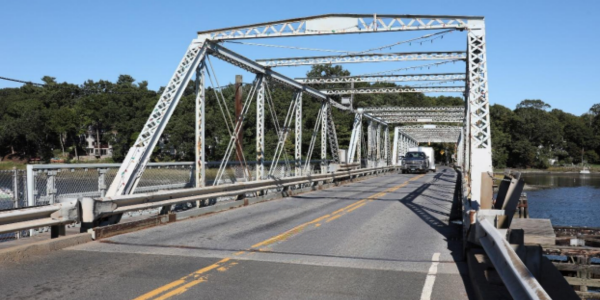
Westport’s own files show that the town once owned the William F. Cribari Memorial Bridge.
What those files cannot yet tell us is whether it still does — and that is a question the town and the state are best placed to answer.
What the records show
In May 2016, Westport’s Historic District Commission accepted a study report on the 1884 Saugatuck River Swing Bridge. Its history section cites three instruments recorded in the Westport land records:
- A deed from Horace Staples to the Saugatuck Bridge Company for the west-side approach (Book 10, Page 583).
- A grant from Chloe Allen of a right of way across her land for the east approach — today’s Bridge Street — on condition that fences be built to protect her livestock (Book 10, Page 584).
- A deed from the Saugatuck Bridge Company conveying the completed bridge, together with that land, to the town of Westport (Book 11, Page 645).
That last deed, recorded in late 1869, appears to be the town’s original title at this crossing.
The story behind it is pure Westport. The Saugatuck Bridge Company was chartered in 1866 to build a private toll bridge. Town meetings voted to fund a bridge, reversed themselves, and voted again — at one point counting heads by stringing a rope down the street. The company finally built a wooden span and deeded it to the town, which paid only after four years and a court order.
When shipworm destroyed that wooden bridge within a decade, it was the town — not the state — that replaced it. On July 15, 1884, a special town meeting voted 40 to 20 to award the work to the Buffalo firm that became the Union Bridge Company. The iron bridge cost $26,700, and the town’s bridge committee accepted it on Nov. 29, 1884. It was built on town land, under a town contract, with town money.
On the historical record, then, the town’s early ownership is well documented.
What the records do not show
Ownership in 1884 is not necessarily ownership in 2026. A great deal can happen to titles over 140 years, and the old deeds cannot by themselves tell us what did happen.
One general principle may help frame the question. As a rule of property law, title to land does not lapse through neglect or the passage of time; it passes by a specific act — a deed, a condemnation, an act of the legislature, or a court judgment. If that rule holds here, the question is not whether the town lost its title by default, but whether some particular statute, order or deed took it — and if so, which one.
Here I should add to what I wrote earlier this year. I pointed then to the 1961–63 state route reclassification as the moment the state’s claim took shape. The same 2016 town report places it earlier: it states that the state “acquired” the bridge around March 1923, when Connecticut created its numbered highway routes. It also notes that in 1894 the town itself petitioned the legislature to have the state take over drawbridges like this one.
Both facts matter, and the report does not explain the basis for its 1923 statement. If the state acquired the bridge by legislative act, formal highway layout, purchase, or condemnation, there should be a document that says so. If “acquired” instead describes the state taking on jurisdiction and the duty to maintain a state highway, that is significant — but it is not necessarily a transfer of title. I have not seen the record that answers this, and I do not want to assume either way. Connecticut statutes governing state highways and town bridges, and any later transfers, may also bear on the question in ways a search of the land records alone will not reveal.
Two further points remain open. First, whether the town received the east approach outright or only a right of way. Second — and this is important — even if the town still holds some interest in the bridge or its approaches, it does not follow that Westport could prevent its replacement.
The state’s authority over a state highway may matter more than who holds title. I am not suggesting otherwise. I simply don’t know, and I suspect few of us following this debate do.
What we should ask for
Rather than argue from incomplete records, Westport deserves a clear public accounting:
- The town Clerk should make Book 11, Page 645, and the two 1869 approach instruments readily available, so residents can read exactly what the town received.
- The town should state its current understanding of who owns the bridge and its approaches, and the documents and legal authority on which that understanding rests.
- CTDOT should identify the instrument by which the town’s interest in the bridge and its approaches passed to the state — whether a deed, a condemnation, a legislative act, or a court judgment — and say whether it relies on the 1923 route designation, the 1961–63 reclassification, or something else.
- The RTM should request a formal title opinion from Connecticut counsel before the town accepts anyone’s characterization of who owns what.
I hope both the town and CTDOT will respond, and that Westport Journal will publish what they say.
Why it matters
CTDOT has announced a preferred plan to replace the bridge at a cost of roughly $78 to $80 million, and has invited others to seek ownership of the old superstructure. Whatever one thinks of replacement, that discussion will be better served by shared facts than by competing assumptions about who owns what. Settling the record is not a vote for or against the bridge. It is the groundwork for an honest decision.
Richard D. Rogovin
Attorney at Law
Chairman, U.S. Bridge
dickrogo@gmail.com
(614) 209-5010
Rogovin is not admitted to practice in Connecticut and writes as a lifelong bridge guy; nothing here is legal advice to the town of Westport.




Recent Comments