
By Ginny Monk / CTMirror.org, with additional reporting by Westport Journal
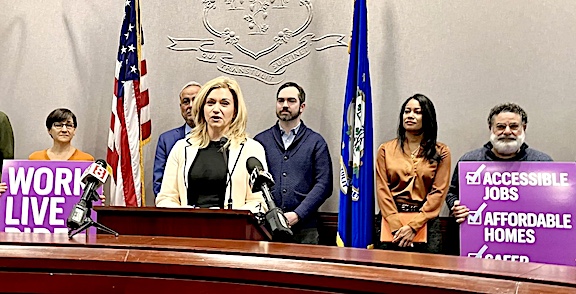
An amended version of a bill that would encourage more housing near train and bus stations around the state was passed by the General Assembly’s Planning and Development Committee on Friday, marking a step forward for one of this session’s major zoning bills.
House Bill 5390, also known as “Work Live Ride,” would offer towns that opt to create transit-oriented communities priority for certain state infrastructure funds.
The idea is to build denser, walkable communities with housing and businesses where people can easily access public transportation.
The bill is backed by advocacy group Desegregate Connecticut, and Democrats said at the end of last legislative session they want to prioritize the concept this year. The organization has advocated for some version of a transit-oriented development bill every year since 2020.
Westporters still have questions
Westport officials got a preview of this year’s proposal earlier in the week when Pete Harrison director of Desegregate Connecticut, joined a meeting of the Planning and Zoning Commission’s Affordable Housing Subcommittee.
Harrison told the group that several changes in the proposed legislation were made at the suggestion of Westporters after a similar meeting last year, when several speakers challenged aspects of the plan.
Still, the revised legislation raised questions at this week’s Westport meeting. The strongest criticism was voiced by Representative Town Meeting member Matthew Mandell, who was skeptical that communities that choose not to participate in the program would not be penalized, particularly by being “de-prioritized” for receiving infrastructure grants designed to be incentives for opting in.
Work Live Ride sponsors, however, say that towns choosing not to participate in the program, designed to promote mixed-use developments around transit hubs, would not lose out in consideration for state grants.
Harrison told the Westport meeting the proposal is primarily a land-use measure, which aims to “align” state and local planning authorities to foster more “walkable, bike-able, transit-rich” multi-use developments linked to public transportation.
The legislation “would get us to actually building,” said state Rep. Eleni Kavros DeGraw, D-Avon, co-chair of the assembly’s Planning and Development Committee.
“I think that’s probably the biggest issue we have is that we continue to not actually build,” she said. “And while I utterly respect the parts of our state that are not interested in building, the parts of our state that are, we need to do everything we can to encourage that.”
Brownfield remediation dropped from bill’s incentives
The amended version of the bill removes brownfield remediation grants from the “discretionary funds” that can be used to encourage towns to create transit-oriented districts.
During a public hearing on the measure, opponents had brought up concerns about losing access to brownfield remediation grants if communities don’t opt to create the transit districts. With the change, the brownfield grants are no longer a part of the list of funds that can be used to incentivize towns to zone for the districts.
The new language specifies that towns that don’t establish the districts are still eligible for discretionary funds, Kavros DeGraw said.
The amended bill also puts much of the power for overseeing and helping with districts’ development in the hands of the Office of Policy and Management rather than the Office of Responsible Growth, which was created last year.
Kavros DeGraw said it’s still likely the Office of Responsible Growth will act as the liaison between towns and the state, but the new wording offers more flexibility. The Office of Responsible Growth exists within OPM.
Advocates say that transit-oriented development would help address a dire lack of housing in the state and help the environment by encouraging people to use public transportation.
H.B. 5390 is also one of the more controversial bills to come through the committee this session.
Opponents fear that if towns don’t opt-in, they’ll be less likely to have access to certain state funds and say it could weaken local control.
GOP favors changes to 8-30g affordable housing law
Republicans also said Friday they want to see more reforms to the state’s 8-30g law, a decades-old state statute that offers legal remedies to developers when towns deny applications to build affordable housing. Towns are exempt if at least 10 percent of their housing is set aside as affordable, and if a developer files a lawsuit under 8-30g, the burden of proof shifts to the town to prove a project was denied for reasons of health or safety.
Committee ranking member state Sen. Ryan Fazio, R-Greenwich, called the transit bill “overly prescriptive.”
“I think we all agree on a couple of different things across party lines, across this committee and this body, which is that first: When we put local communities in the driver’s seat with regard to governing their towns and cities that we get the best results,” Fazio said. “And second: That we also need to create housing and development policies in this state.”
Housing experts have criticized many Republican attempts to reform 8-30g, saying the proposals would not lead to an increase in housing or improvements in affordability.
Payments in lieu of affordable units
While the previous transit bill had certain measures to ensure that larger developments had a certain percentage of affordability, the new bill allows developers to give money to a municipal fund — such as Westport’s recently created Affordable Housing Trust Fund — to be used for creation of affordable housing instead of setting aside affordable housing.
It also sets up a state fund for public sewer and water rehabilitation and expansion. Lack of access to public sewers has been a roadblock for small towns in building multi-family housing, officials have said.
Transit-oriented development is a land-use concept that’s been growing in popularity nationwide as many states and municipalities try to find ways to reduce sprawl. More people, particularly millennials and Gen Z, say they want to live in walkable communities. As millennials came of age, more moved to urban centers than older generations.
Ranking member state Rep. Joe Zullo, R-East Haven, said he’s concerned about allowing money to be invested in a housing fund rather than designating affordable housing.
“I think that significantly undermines the intent and purpose of the bill,” Zullo said.
Lawmakers from both sides of the aisle, however, said the bill has come a long way in the last few years.
“I just am also mindful of the fact that certainly the use of state funds is understandably the concern about assuring that our communities are getting what they need,” said state Rep. Cristin McCarthy-Vahey, D-Fairfield.
“Of equal concern to me is that we as a state are prioritizing what’s most important. Certainly, housing and assuring that people have a safe, secure and affordable place to live is high on that list of needs,” she said.
Co-chair state Sen. MD Rahman, D-Manchester, said he’s hopeful the bill will also be a boon to Connecticut’s economy.
“This is also tied up with our economy because when someone can’t find housing in walking distance or in a transit-oriented community area, our business owner is also struggling to hire,” Rahman said Friday.
The bill is set to go to the full House of Representatives for review next.











Interesting that brownfield remediation was pulled from the bill, but other such infrastructure monies could still be in jeopardy. Sort of proves the point that towns not opting in would be deprioritized.
If you’d like to learn more about what’s in many of these bills and how they might affect our town, tune into a Webinar I will be panelist on tomorrow Monday night 7pm. link https://tinyurl.com/CT169Ask