

By Linda Conner Lambeck
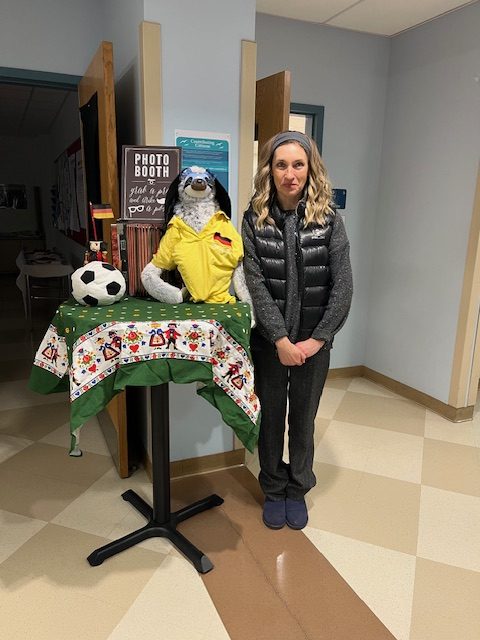
A Staples High School teacher of German and some of her students have added their voices to an effort to establish an official German Trade Commission in Connecticut.
“It could have a meaningful impact on our German program here in Westport,” said Liuba Ulianova, a teacher at Staples since 2005.
“I think it would really open doors,” said Josephine Lewertoff, 17, a Staples junior. “I think it would provide a lot more opportunities to use the language.”
In written testimony in support of Senate Bill 132, which had a public hearing before the legislature’s Commerce Committee on February 17, Lewertoff said more opportunities to use German is motivation to keep studying the language.
The bill would establish a Connecticut-German Trade Commission made up of lawmakers, individuals appointed by lawmakers and the governor’s office, along with representatives of higher education, a local chamber of commerce in the state, and two representatives of German or German-American communities in the state.
The group would get no pay but would meet to advance bilateral trade and investment between the state and Germany, promote business and academic exchanges between the state and Germany and encourage mutual economic support and investment. The commission would report the legislature.
Connecticut established a trade commission with Ireland in 2024 and Puerto Rico in 2025. Along with Germany, there is also a proposal this year to establish a trade commission with India.
At the public hearing held in Hartford last week, Anke Finger, a University of Connecticut professor of German Studies suggested the effort will not only solidify existing relationships but send a signal that Connecticut remains a trusted and globally engaged partner in even in times of uncertainty.
“It is important for us to reach out,” Finger testified.
Sebastian Wogenstein, an associate professor of German at UCONN wrote to the committee that between tariffs, geopolitical conflicts and domestic disruptions that hurt the United States’ reputation globally, the establishment of a Connecticut-Germany Trade commission would send a signal that Connecticut remains a trusted and globally engaged partner.
Ulianova agrees. A trade commission, she said, would not duplicate what already exists, rather it would formalize, coordinate, and strategically expand those relationships.
“Currently, the presence of German companies in Connecticut is strong but decentralized,” Ulianova said.
A Trade Commission, according to Ulianova, could attract additional German investment to the state, facilitate partnerships between businesses, universities, and schools, promote workforce development initiatives and strengthen cultural and educational exchange.
“This means more structured collaboration rather than informal connections, “Ulianova said.
From an educational perspective, a trade commission would also create a stronger justification for maintaining and expanding German Language programs, she added.
At Staples, there are about 80 students taking German at four levels from German 1 to an AP and UCONN Early College Experience class that offers college credits.
This year, the popularity in the courses has led to two German 1 classes instead of one.
In 2024, Staples placed first at the UCONN German Quiz Bowl.
Westport is not alone in offering German. So does Wilton, Greenwich, Chesire and East Lyme. UCONN also offers bachelor and graduate degrees in German.
Lewertoff takes AP German at Staples but has studied the language on weekends at the German School of Connecticut in Stamford since she was in kindergarten.
Her parents are from Germany and speak it at home. Her father worked for Deutsche Bank, a German company in Greenwich. Her mom is an attorney.
She expects to use the language in whatever career path she chooses. Right now, she said she is thinking of majoring in International Relations.
Were she to intern at a German-owned companies in Connecticut, there would be plenty from which to choose.
Well over 100 German companies do business in Connecticut, in the areas of advanced manufacturing, aerospace, biotech, and financial services sectors. Those companies are responsible for more than 12,400 local jobs.
In addition, Connecticut exported more than $2.1 billion in goods to Germany in 2022, according to the state.
In 2024, Governor Lamont led a delegation to Germany to solidify and strengthen economic and cultural ties between Connecticut and Germany.
As a result, Ulianova said companies such as Boehringer Ingelheim in Ridgefield, TRUMPF Inc., in Farmington, and Deutsche Bank in Greenwich may increasingly seek interns and professionals with exposure to German language and culture.
“Students do not need to be fully fluent; cultural awareness and foundational language skills are highly valued,” Ulianova said.
It is not yet clear when the Commerce Committee will vote on the bill.
The bill: https://www.cga.ct.gov/2026/TOB/S/PDF/2026SB-00132-R00-SB.PDF








Recent Comments