
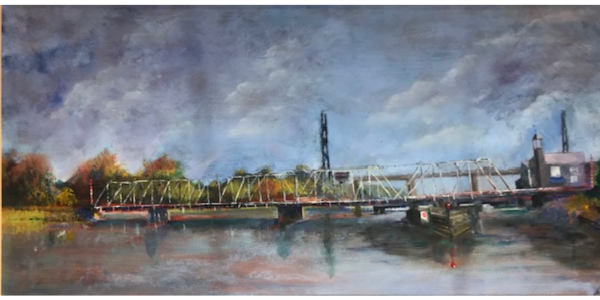
Editor’s note: the below is an opinion from Westporter Werner Liepolt.
With Governor Ned Lamont speaking today at the Westport Library (11 a.m., free registration required here), now is a good time to bring him into the discussion about the future of the Cribari Bridge
Westport’s First Selectman last week announced the formation of a Cribari Bridge Advisory Committee, intended to bring “technical expertise and community perspectives” to the Town’s engagement with the state.
That is a constructive step.
But it raises a more important question—one that now extends beyond Westport:
Will this process produce a decision grounded in current facts, or is it moving forward on a record that no longer reflects present conditions?
That is a question not only for the Town, but for the State—and ultimately for Governor Ned Lamont, whose administration is responsible for ensuring that major infrastructure decisions meet the standards of transparency, accountability, and sound analysis that the public expects.
An environmental assessment past its useful life
At the March 19, 2026 public hearing, the Connecticut Department of Transportation presented what it described as an updated Environmental Assessment.
The cover said “February 2026,” but in substance, it remains the 2020 document—a study CTDOT itself acknowledged has a shelf life of approximately two to three years before requiring reevaluation.
Six years later, it is still being used to support a major infrastructure decision.
No updated traffic baseline.
No post-pandemic analysis.
No reassessment of regional patterns.
No multi-seasonal or upland visual analysis.
History matters. But history does not have an expiration date—and neither should the responsibility to revisit assumptions when conditions change.
If the foundation is outdated, no advisory structure will correct it.
The question that determines everything
There is one question that should be driving this entire discussion:
What happens if this corridor begins to function as an alternative to I-95?
Not assumed.
Not minimized.
Studied. Modeled. Understood.
The current Environmental Assessment does not answer that question.
Instead, it relies on an earlier assumption that trucks and through-traffic would not find the route “desirable”—formed before real-time navigation systems began shaping traffic patterns.
Today, routing decisions are made by algorithms.
If the corridor is upgraded to carry heavier loads, it will be used that way.
A process that does not test that outcome is not evaluating risk.
It is accepting it.
A historic district that exists only on paper
The Cribari Bridge is not an isolated structure. It sits within the Bridge Street National Register Historic District and along a designated Connecticut scenic roadway.
Those designations exist for a reason.
Yet the Area of Potential Effects has been drawn so narrowly that 90% of the district is effectively excluded from consideration… yet will be affected on a 10+ property Right of Way list of properties that have been identified but not made public.
At the same time, historic character has been removed from the project’s stated Purpose and Need.
That combination does not eliminate impacts.
It eliminates the requirement to account for them.
The real test — for the committee and the state
The First Selectman has said the Advisory Committee will “ground decisions in facts.”
Those are the right words.
But this moment calls for more than local engagement. It calls for state-level accountability to ensure that the process itself is sound.
Because a process does not create legitimacy by moving forward.
It creates legitimacy by being complete.
At a minimum, that means:
- A fully updated Environmental Assessment
- Modern traffic modeling reflecting current conditions
- A properly defined Area of Potential Effects that includes the full historic district
Anything less risks giving the appearance of scrutiny while leaving the underlying assumptions untouched.
A question of governance — not just infrastructure
Westport residents are entitled to more than forward motion.
They are entitled to decisions grounded in current evidence, full transparency, and independent judgment.
That is not simply a local concern.
It is a question of governance.
One question for the Governor
As Governor Lamont meets with Westport residents, there is a simple question worth asking:
Will the State of Connecticut ensure that the decision on the Cribari Bridge is made on a current, fully evaluated record—or allow it to proceed based on assumptions that have not been meaningfully revisited since 2020?
Westport does not need another process.
It needs a decision that is actually informed.
And that depends on whether the State is willing to insist that the questions—long raised and still unanswered—are fully addressed before the decision is made.
Werner Liepolt
Westport




I want to thank Werner for diligently making the case for transparency.
I would add, when making a point or asking a Governor to jump into an issue, it can be handy to do away with lists…lists tend to muck things up, so I like how you have reduced it to one question.
Mine would be, for the sake of simplicity and clarity… as Governor, are you going to help us save our historic bridge and help us keep the trucks from i95 out of our neighborhood?
SAVE THE BRIDGE
The more nuanced the question, the more wiggle room a politician gets.
I would ask him myself but I am currently out of town. I think our first select person wants to see exactly where the townsfolk fall on the issue.
As many have stated, if a new bridge is built trucks will drive on it— no matter what the town regs say. It’s gonna be tough but possible to widen the old bridge and leave low beams to block trucks but create bicycle friendly zone. Uh on a side note bicycling in Saugatuck is slightly dangerous. I pedaled across America solo during the pandemic. Anytime you are near a train station or highway off-ramps bicycles suffer from danger. If the old bridge is simply restored with some attention to walking zones given it is more simple.
A list of reasons why the bridge should be saved can be problematic because brains tends to wander.
Save The Bridge and Save Our Town— from trucks!
They can’t build a bridge that a “wayward” tractor-trailer can strike. Anything lower thru 13’6 won’t make a year until 40-ton battle ram impacts it. They have been transparent with that point from the jump; we’ll have to find another way.
They could concrete in a steel I beam on land just before the bridge on each side at 13 feet that would tend to stop any tall truck trying traffic.
And when a truck hits it, who carries the liability? It’s just not a realistic option. We’ll need to find another solution since Condot made it clear from the start they aren’t building a low span with federal tax funds. At 13′ 10″ now, it just isn’t going to happen.
What do you think is realistic?
I see a dilemma: the terribly unique structure is 147 years old. Westporters love it because it ads a sense of permanence in changing chaotic world. It looks like something from “the old days”. It functions perfectly to let tall ships into Westport by swiveling.
What’s your bottom line idea. I don’t have a horse in it other than my love for the old school Westport that I grew up with in the late 60s early 70s. Replacement with something different is sacrilege for anybody from that era.
I can see however, that the thing is old and the state owns the road, if not the bridge itself.
For me the bottom line is that 18 wheelers should never be allowed over that pass, because it is just too convenient for those hulking monsters to not use it all day. It’s bloody parallel to the highway, no less, the perfect short cut now the i95 is backed up every morning. I remember the tolls, when they were removed it was so freeing, you could just zoom to Norwalk.
For me, the authority resides with our first selectman and our Governor, they can make the final call. They can bend any rule to save a historic landmark structure that preserves what Westport is all about, if they want. Or they can fall back on the panels or dot.
What’s your opinion?
If you ask me, I don’t even see an issue. But if you want to build a different bridge there, replacement— this is where you have a problem. Who pays liability if it falls into the river?
SAVE THE BRIDGE