

By Andy Brophy
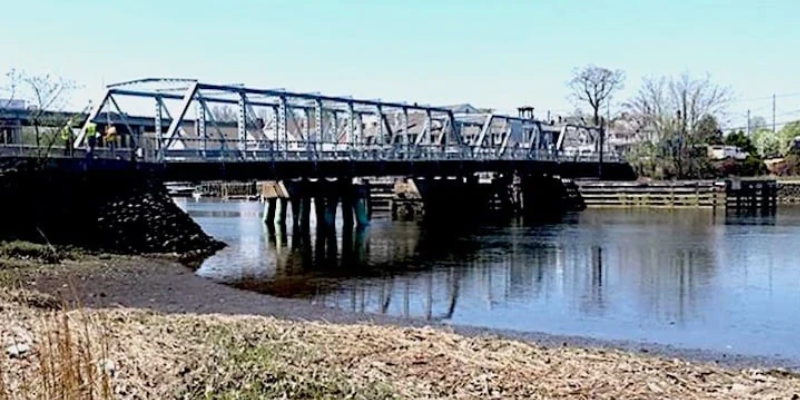
Preventing trucks on Interstate 95 from traveling across a new William F. Cribari Memorial Bridge in Westport was the focus of a town committee meeting Monday night.
Melissa Levy, chairwoman of the Representative Town Meeting’s Transit Committee, said the state Department of Transportation next week would present its “selected alternative” for the 142-year-old bridge that carries motorists on Bridge Street over the Saugatuck River.
The meeting is at 7 p.m. Nov. 12 in Town Hall.
Residents believe the DOT will call for the Cribari Bridge to be replaced, instead of repaired, and are concerned the replacement bridge will be large enough for trucks to leave I-95 and use the bridge when the highway is jammed with traffic.
“I think we all know what their preferred alternative is,” said Kristin Schneeman, RTM D-9.

Chris Tait, RTM D-1, said the RTM previously had “a lot of consensus” on not allowing trucks on the Cribari Bridge once it was replaced or repaired. “We, as a town, said, ‘Absolutely no trucks, period,’ “ Tait said. He questioned whether that position should be reinforced before the DOT’s Nov. 12 meeting.
Levy said the RTM’s March 3 “sense of the meeting resolution” called for the Cribari Bridge to be restored, rehabilitated or replaced as soon as practical; to maintain its historic design; to have pedestrian and bike lanes; and to have a height restriction so no tractor trailers could traverse it.
The March 3 vote was 20-1, with four abstentions, according to Jeff Wieser, the RTM’s moderator.
Wieser said he didn’t think the RTM needed to reiterate its position against having trucks cross a new Cribari Bridge. “I think we had a very unified vote, and I think we should parade that and wave it in the state’s face,” he said.
Levy said the state DOT had received 833 comments since March 26 from Westport residents about the future of the Cribari Bridge. “They know how we feel,” she said. “At each turn, people have said they don’t want trucks … No trucks, no trucks.”
“We have the RTM saying what we said since March,” she said.

Gail Coykendall, RTM D-1, questioned whether the RTM could pass an ordinance, essentially a town law, that forbids trucks on the Cribari Bridge. “We should pass an ordinance that keeps tractor trailer traffic off the road,” she said. “The state will pay for the bridge, but Westport has to live with it.”
Levy said state law limits a town’s ability to regulate traffic on state highways. She said that didn’t mean a truck restriction was impossible, but town officials need to understand legal mechanisms to do it. Though unclear, Bridge Street appears to be a state highway because it’s designated as part of Connecticut Route 136.
The predecessor to the current Cribari Bridge was a toll bridge and Victoria Wylie, RTM D-4, suggested it could be a toll bridge to discourage traffic from I-95 crossing it.
Levy said all Westport residents could be exempt from the toll but added she was joking.
Tait said Route 136 in downtown Rowayton did not allow trucks, and Schneeman said East Haddam’s historic swing bridge, which opened in 1913, was rehabilitated – not replaced – last year.
“Why does East Haddam get to keep their historic bridge and we don’t?” she asked.

The Cribari Bridge, built in 1884, is on the National Register of Historic Places, and Schneeman questioned whether the bridge could be replaced if a feasible and prudent alternative existed.
She said the bridge’s historic designation could be a strategy to prevent it from being taken apart and that rehabilitating and preserving the bridge “gives us the best chance of a physical height restriction.”
Tait questioned whether First Selectman Kevin Christie had formed a committee on the Cribari Bridge, and Levy said while Christie had announced in April he was going to have a Cribari Bridge committee, he was still in the process of forming it and would have it by Nov. 12.
“It hasn’t been fully formed,” Levy said. She said it’d be helpful to have a member of the RTM’s Transit Committee on Christie’s committee.
“You had more than 10 months to put together a committee,” Andrew Colabella, RTM D-4, said referring to Christie. “That’s not how government goes and that’s not how it should.”
Shannon Taylor, a Bridge Street resident, said Westport’s selectmen have to submit a formal request to the state that trucks not be allowed on the new Cribari Bridge. “We don’t want trucks on this road. That seems to be the biggest overarching theme on this bridge,” she said. “It has to come from the selectmen.”

Several RTM members said they heard a rumor that the state, through the federal government, would only pay for a replacement Cribari Bridge and would not pay for the bridge to be repaired.
“I’ve heard from different people the same rumor,” said Wendy Batteau, RTM D-8. “I don’t think it’s a rumor.”
The Federal Highway Administration also has to approve plans for the Cribari Bridge and its approval is “a separate step,” Levy said.
The 11-member Transit Committee formed its Cribari Bridge subcommittee on Oct. 27, and no Transit Committee members at the time said they didn’t want to be on it.
“Westport still has a voice, and we need to understand how to best use it,” Levy said.
Coykendall said, “I know we’re kind of down to the wire.”





Thank you to the RTM subcommittee for pursuing these questions. I missed Monday’s meeting and appreciate this account.
The public hearing turnout, the 800+ comments submitted to CTDOT, the proliferation of “No Trucks” signage and the Change.org petition reflect substantial, sustained community interest, engagement, and deep concern.
The subcommittee has an important opportunity to finally translate that engagement into specific answers and enforceable protections.
Before November 12, could CTDOT and FHWA provide written answers to three questions? What legally enforceable truck restrictions are available, who must initiate and approve them, and can they be secured before a bridge design is finalized? What federal funding requirements, if any, would prevent rehabilitation rather than replacement? And how have alternatives been evaluated for their effects on the Bridge Street National Register Historic District, as well as the bridge itself?
The reported claim that federal funding is available only for replacement deserves direct confirmation from FHWA, with the applicable requirements identified. The RTM has clearly expressed the community’s concerns. Its next valuable contribution could be to obtain those answers—and establish how promised protections would become binding commitments.
Here is a short video about the bridge and the need to come to next Thursday’s meeting in town hall.
https://youtube.com/shorts/iYqx5mzBgDQ?si=ev0FcVl6q4WAiQPh